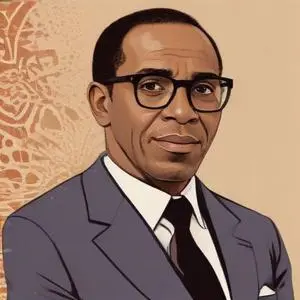
Frantz Fanon: The Radical Voice of Decolonization
A Life Dedicated to Liberation
Frantz Fanon was a French Afro-Caribbean psychiatrist, philosopher, and revolutionary thinker, renowned for his influential works in the fields of postcolonial studies, critical theory, and Marxism. His groundbreaking ideas on the psychopathology of colonization, decolonization, and the human, social, and cultural consequences of these processes have made him a legendary figure in the struggle for liberation and social justice.
Early Life and Education
Born on July 20, 1925, in Martinique, a French colony in the Caribbean, Fanon grew up in a socioeconomically middle-class family. His father, Félix Casimir Fanon, worked as a customs agent, and his mother, Élanore Médélice, was of Afro-Martinican and white Alsatian descent and worked as a shopkeeper. Fanon was the third of four sons in a family of eight children. He was particularly close to his sister Gabrielle, who sadly passed away at a young age.
Fanon pursued his education at the Lycée Schoelcher in Martinique, where he was exposed to the works of educator and writer,
Aimé Césaire, who would later become a significant influence on his life and work. In 1943, Fanon moved to France to continue his studies in medicine and psychiatry.
Career Highlights and Major Works
Fanon's most notable works include:
- Black Skin, White Masks (1952), a seminal book that explores the psychological effects of colonialism on the colonized and the dynamics of racism.
- The Wretched of the Earth (1961), a powerful manifesto that critiques colonialism and advocates for violent revolution as a means of liberation.
- Toward the African Revolution (1964), a collection of essays that analyze the struggles for independence and unity in Africa.
Influence on Modern Society
Fanon's ideas have had a profound impact on various social and political movements, including:
- Palestinian national liberation movement
- Sri Lankan independence movement
- South African anti-apartheid movement
- United States civil rights movement
His work has also influenced notable figures such as:
- Steve Biko, South African anti-apartheid activist
- Malcolm X, American civil rights leader
- Che Guevara, Argentine revolutionary
Philosophical Contributions and Beliefs
Fanon's philosophical framework is rooted in Marxism, existentialism, and humanism. He believed in the importance of:
- Decolonization as a necessary step towards true liberation
- The need for violent revolution to overthrow oppressive systems
- The importance of community and collective action in achieving social change
Personal Milestones and Key Life Events
Fanon's life was marked by significant events, including:
- Joining the Algerian National Liberation Front (FLN) in 1957
- Meeting with Jean-Paul Sartre, French philosopher and writer, in 1959
- Developing leukemia, which ultimately led to his untimely death on December 6, 1961, at the age of 36
Legacy and Impact
Frantz Fanon's life and work have inspired generations of scholars, activists, and revolutionaries. His ideas continue to shape our understanding of colonialism, racism, and social justice. As a testament to his enduring legacy, Fanon's work remains a vital part of contemporary debates on decolonization, liberation, and human rights.
FAQ
What are Frantz Fanons contributions to postcolonial theory?
Frantz Fanon is a key figure in postcolonial theory, known for his work on the psychological and philosophical effects of colonialism on individuals and societies.
What is Frantz Fanons book Black Skin, White Masks about?
Frantz Fanons book Black Skin, White Masks is a seminal work that explores the experiences of black people in a white-dominated world, examining the psychological effects of racism and colonialism.
How did Frantz Fanons work influence the Civil Rights Movement?
Frantz Fanons work had a significant impact on the Civil Rights Movement, influencing thinkers like Malcolm X and Stokely Carmichael, who drew on his ideas to challenge racism and colonialism.
What are the key concepts in Frantz Fanons theory of decolonization?
Frantz Fanons theory of decolonization emphasizes the need for radical transformation and the rejection of colonial ideologies, highlighting the importance of self-determination and autonomy for colonized peoples.
How has Frantz Fanons work influenced contemporary social justice movements?
Frantz Fanons work continues to influence contemporary social justice movements, informing critiques of racism, colonialism, and imperialism, and inspiring new generations of activists and scholars.