


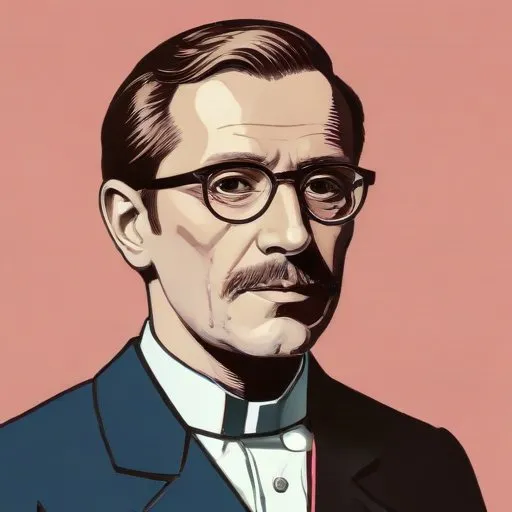
A Swedish surgeon who composed music in his spare time, creating symphonies and operas that were ahead of their time, but only gained recognition after his death.
Franz Berwald, a Swedish Romantic composer and violinist, is best known for his exquisite string quartets and symphonies that evoke a sense of longing and nostalgia. Although he made his living as an orthopedist and later as a manager of a saw mill and glass factory, his true passion remained in music, which unfortunately gained more appreciation after his death than during his lifetime.
Born in Stockholm on July 23, 1796, Berwald came from a family with a rich musical heritage, with his father being a violinist in the Royal Opera Orchestra. He was taught the violin from a young age and soon appeared in concerts, showcasing his impressive talent. In 1809, he started working at the Royal Chapel, playing in the court orchestra and opera, and receiving lessons from Edouard du Puy.
During the summers, Berwald would travel around Scandinavia, Finland, and Russia, absorbing the cultural influences that would later shape his compositions. His early works, including a septet and a serenade, were considered worthy by the composer himself in his later years.
In 1818, Berwald started publishing the Musikalisk journal, later renamed Journal de musique, which featured easy piano pieces and songs by various composers, including some of his own original work. However, his Violin Concerto, premiered by his brother August in 1821, was not well received, with some audience members laughing during the slow movement.
Following the death of his father in 1825, Berwald's family faced dire economic circumstances. He applied for several scholarships but only received one from the King, which enabled him to study in Berlin. Despite his dedication to music, he had to put his compositional pursuits on hold and focus on making a living.
In 1835, Berwald started an orthopedic and physiotherapy clinic in Berlin, which became profitable and allowed him to invent orthopedic devices that remained in use decades after his death. He stopped composing during this period, only resuming in 1841 after moving to Vienna and marrying Mathilde Scherer.
It was only after his death on April 3, 1868, that Berwald's music gained the recognition it deserved. His symphonies and string quartets, characterized by their romantic elegance and soaring melodies, have become staples of classical music repertoire.
In conclusion, Franz Berwald's story serves as a testament to the power of perseverance and creativity. Despite facing setbacks and financial struggles, he remained true to his artistic vision, leaving behind a legacy that continues to captivate audiences to this day.
Born in 1707
Developed the system of binomial nomenclature, which is still used today to classify and name living organisms. This system has had a profound impact on the fields of biology, ecology, and conservation.
Born in 1701
A Swedish astronomer, physicist, and mathematician who developed the Celsius temperature scale, still widely used today to measure temperature. He also made significant contributions to astronomy, including the discovery of the aurora borealis.
Born in 1901
A Swedish politician who served as Prime Minister from 1946 to 1969, leading the country through a period of significant social and economic reform. He's known for his progressive policies and strong leadership.
99 Years Old
A Swedish statesman who served as Prime Minister of Sweden from 1969 to 1976 and 1982 to 1986, known for his progressive policies and international diplomacy. Assassinated in 1986, his murder remains unsolved.
Born in 1902
A Swedish sociologist and politician who pioneered disarmament and women's rights, earning a Nobel Peace Prize in 1982 for her efforts to reduce nuclear proliferation.
77 Years Old
The 31st Prime Minister of Sweden, serving from 1996 to 2006, known for leading the country through a period of economic reform and social change. He's also recognized for his efforts to strengthen the European Union.
60 Years Old
The 42nd Prime Minister of Sweden, serving from 2006 to 2014, known for leading a center-right government and implementing significant reforms in taxation and labor market policies.
