


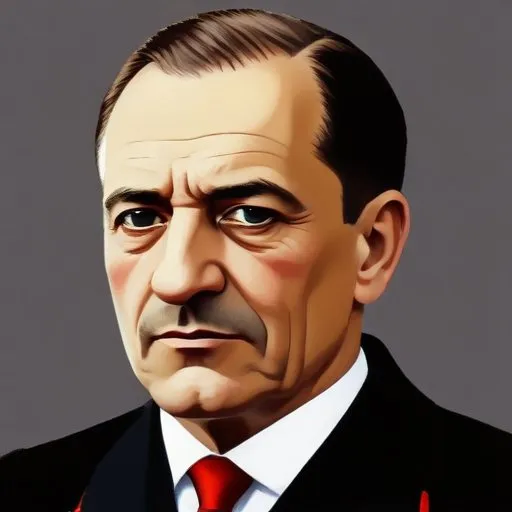
A German captain-turned-politician who served as Reich Minister for Labour, implementing policies that forced Jews out of the workforce and introduced the Reich Labour Service, a precursor to Nazi forced labour camps. He played a significant role in shaping Nazi Germany's labour policies.
Franz Seldte, a German politician and reactionary, is notoriously known for serving as the Reich Minister for Labour in Nazi Germany, a role that oversaw the brutal oppression of workers and the entrenchment of fascist ideologies. As a founding leader of Der Stahlhelm, a World War I veterans' organization, Seldte's rise to power was marked by his militant nationalism and anti-democratic sentiments.
Born on June 29, 1882, in Magdeburg, Prussia, Seldte was the son of a factory owner who produced chemical products and soda water. He attended the Wilhelm-Raabe-Gymnasium in Magdeburg and later pursued chemistry studies at the universities of Braunschweig and Greifswald. After an apprenticeship as a salesman, Seldte took over his father's business in 1908, following his father's untimely death.
In 1918, as a reaction to the German Revolution and the Treaty of Versailles, Seldte founded Der Stahlhelm, Bund der Frontsoldaten (The Steel Helmet, League of Front Soldiers). This organization, born out of Seldte's disdain for the Weimar Republic, sought to unite war veterans against the perceived injustices of the Treaty of Versailles and German war reparations. Seldte's vision for Der Stahlhelm was to channel the spirit of front soldiers against the "swinish revolution" taking place in Germany.
As the leader of Der Stahlhelm, Seldte became a prominent figure in German politics, especially within the national conservative German National People's Party (DNVP). Despite facing challenges from his deputy leader, Theodor Duesterberg, Seldte's organization grew in influence, eventually uniting with the DNVP under Alfred Hugenberg, the Pan-German League, and the Nazi Party to initiate a German referendum against the Young Plan in 1929.
In 1933, Seldte's allegiance to the Nazi Party earned him the appointment as the Reich Minister for Labour, a position he held until his death in 1947. As Minister, Seldte oversaw the implementation of forced labour, the suppression of workers' rights, and the perpetuation of Nazi ideology. His ministry was marked by brutal crackdowns on labour unions and the exploitation of workers, solidifying Seldte's reputation as a key figure in the Nazi regime.
Franz Seldte's legacy is marred by his association with the Nazi Party and his role in perpetuating fascist ideologies. His contributions to the rise of Nazi Germany and his involvement in human rights abuses have cemented his place as a controversial figure in modern history. Despite his influence, Seldte's actions serve as a stark reminder of the dangers of unchecked nationalism and the importance of protecting human rights.
Franz Seldte's life serves as a cautionary tale about the dangers of extremism and the importance of protecting human rights. As we reflect on his legacy, we are reminded of the devastating consequences of unchecked nationalism and the importance of promoting tolerance, empathy, and understanding.
Born in 1889
The dictator of Nazi Germany, responsible for the genocide of six million Jews and millions of other people during World War II, and infamous for his extreme nationalist and anti-Semitic ideology.
Born in 1893
A high-ranking Nazi official, he was a decorated World War I fighter pilot and later became a prominent politician, serving as Minister President of Prussia. He's infamous for his role in the Nazi regime and war crimes trials.
Born in 1897
A mastermind of Nazi propaganda, he crafted a persuasive narrative that fueled the Third Reich's rise to power, leaving a lasting impact on the world.
Born in 1894
A high-ranking Nazi official who flew to Scotland on a solo mission to negotiate peace with the UK, but was instead arrested and imprisoned.
Born in 1893
A German diplomat who served as the Nazi regime's Foreign Minister, orchestrating key alliances and treaties that led to World War II. He was a close associate of Adolf Hitler and played a crucial role in shaping Nazi foreign policy.
Born in 1900
Leading the SS and Gestapo, he oversaw the Nazi regime's brutal security apparatus and implemented the "Final Solution," orchestrating the genocide of six million Jews during World War II.
Born in 1887
A high-ranking Nazi official who played a key role in the party's early development and was a close ally of Adolf Hitler, but was eventually purged and executed during the Night of the Long Knives. He's infamous for his leadership of the Sturmabteilung (SA) paramilitary group.
