


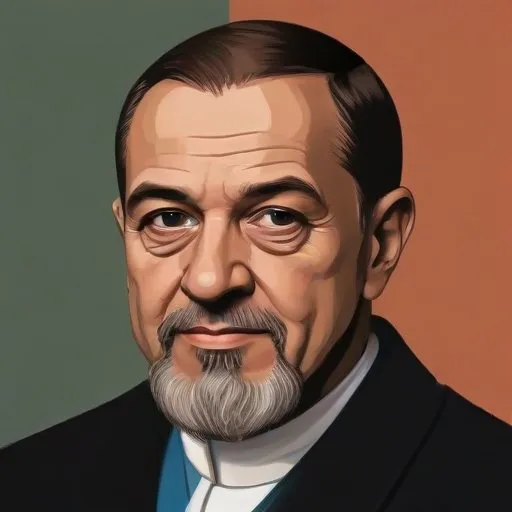
Founded the Conference of Charity, a forerunner to the St. Vincent de Paul Society, which provides aid the to poor and marginalized. He's also a prominent historian and scholar of the Middle Ages.
Frdric Ozanam is renowned for founding the Conference of Charity, later known as the Society of Saint Vincent de Paul, a humanitarian organization that has been instrumental in alleviating poverty and suffering worldwide. Through his tireless efforts, Ozanam advocated for equal rights, education, and social justice, leaving an indelible mark on modern society.
Born on April 23, 1813, in Milan, Italy, Frdric Ozanam was the fifth of 14 children to Jean and Marie Ozanam. His family, with distant Jewish connections, had settled in the Lyon region of France for centuries. Ozanam's ancestral lineage boasted a notable mathematician, Jacques Ozanam (1640-1717). His father, Jean, served in the French Republic's armies before turning to trade, teaching, and eventually medicine.
Ozanam's early years were marked by a period of doubt regarding his Catholic faith, which was later strengthened by the influence of his teacher, Abbé Joseph-Mathias Noirot. This spiritual foundation propelled Ozanam to publish Rflexions sur la Doctrine de Saint-Simon, a pamphlet critiquing Saint-Simonianism, at just 18 years old. This work caught the attention of French poet and politician Alphonse de Lamartine, who recognized Ozanam's potential.
In 1831, Ozanam helped establish the Association for the Propagation of the Faith, a lay Catholic organization supporting Catholic missionaries. This endeavor showcased his commitment to social justice and education. While studying law in Paris, Ozanam collaborated with the Ampère family, further solidifying his bonds with the community.
In 1833, Ozanam, along with six fellow students, founded the Conference of Charity, which would later become the Society of Saint Vincent de Paul. This organization focuses on providing aid to those in need, promoting education, and advocating for equal rights. The society's growth and success are a testament to Ozanam's vision and perseverance.
Frdric Ozanam's remarkable life came to an end on September 8, 1853. However, his legacy continued to inspire generations. In 1997, Pope John Paul II beatified Ozanam in the Cathedral of Notre-Dame de Paris, solidifying his position as a champion of social justice and charity. His feast day is celebrated on September 9.
Ozanam's philosophical stance emphasized the importance of education, social justice, and charity. He believed in empowering individuals to create positive change, rather than simply providing temporary aid. This vision continues to guide the Society of Saint Vincent de Paul's efforts worldwide.
"Let us strive to make our own the zeal, the charity, the devotedness, the spirit of sacrifice of our predecessors."
Frdric Ozanam's remarkable journey serves as a beacon of hope, inspiring generations to strive for a more just and equitable society. His legacy continues to shape the world, a testament to the power of compassion, education, and advocacy.
Born in 1581
A 17th-century French priest dedicated his life to serving the poor and marginalized, establishing a congregation of priests and nuns to provide aid and comfort to those in need. He's revered for his selfless charity and compassion.
Born in 1768
A French historian and politician who served as Minister of Foreign Affairs, known for his influential writings on French history and politics, shaping the country's identity and foreign policy.
Born in 1790
A 19th-century French poet and politician who served as the country's Head of State, known for his romantic poetry and instrumental role in the French Revolution of 1848.
Born in 1772
A utopian socialist who envisioned a society where people lived in harmony with their passions and the environment, and is known for his innovative ideas on social organization and urban planning.
Born in 1809
A 19th-century French economist and politician who advocated for anarchism, socialism, and mutualism, and is known for coining the phrase "Property is Theft."
Born in 1805
A 19th-century French historian and philosopher who traveled to America to study its democracy, producing a seminal work on the country's political and social structures. He's known for his insightful commentary on the American experiment and its implications for modern democracy.
