


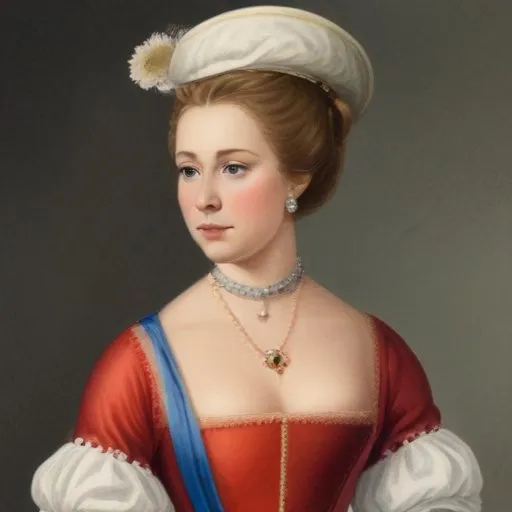
The queen who brought a touch of elegance to the Swedish royal court, known for her cultural and artistic pursuits, and her tumultuous marriage that ended in exile.
Frederica of Baden, born Frederica Dorothea Wilhelmina, was the Queen of Sweden from 1797 to 1809, making her one of the most prominent women of her time. She is best known for being the consort of King Gustav IV Adolf, a marriage that was arranged to preserve an alliance between Sweden and Russia.
Frederica was born on March 12, 1781, at Karlsruhe Palace in the Grand Duchy of Baden, as the daughter of Karl Ludwig of Baden and Amalie of Hesse-Darmstadt. Despite her royal upbringing, she received a conventional and shallow education from a French-Swiss governess, which would later lead to her being described as intellectually shallow.
In 1792, Frederica's mother visited Russia, accompanied by Frederica and her sister Louise of Baden, to potentially secure a marriage between one of the sisters and Grand Duke Alexander of Russia. Although Louise was chosen to marry Alexander, Frederica's fate was sealed when she married King Gustav IV Adolf of Sweden in October 1797. The marriage was arranged to maintain the alliance between Sweden and Russia, as Gustav IV Adolf had previously refused to marry other potential brides.
As Queen, Frederica was known for her beauty, but also for her weak constitution, having suffered from rheumatism since childhood. Despite her physical limitations, she played an important role in Swedish politics, albeit indirectly, as Gustav IV Adolf was known to seek her counsel on various matters.
Frederica's legacy is often overshadowed by her husband's reign, but her marriage and role as Queen of Sweden helped maintain the fragile balance of power in Europe during the late 18th century. Her story serves as a reminder of the complex web of alliances and marriages that shaped European history.
Frederica of Baden's life and reign were marked by the complexities of European politics and the intricacies of royal marriages. While she may not have left a lasting impact on Swedish history, her story serves as a reminder of the importance of understanding the historical context in which women like her lived and navigated their roles.
Born in 1778
King of Sweden from 1792 to 1809, known for his disastrous foreign policy and military failures, leading to the loss of Finland to Russia.
Born in 1748
King of Sweden and Norway from 1809 to 1818, known for his role in the Finnish War and the Convention of Moss, which led to the union of Sweden and Norway.
Born in 1729
Empress of Russia from 1762 to 1796, she transformed her country into a major European power, modernizing its culture, politics, and economy through numerous reforms and conquests.
Born in 1818
Liberalizing reforms and abolishing serfdom in Russia, earning the nickname "Liberator."
Born in 1769
A French military leader who rose to prominence during the French Revolution and became Emperor of France, known for his military conquests and reorganization of Europe. He is also famous for his Napoleonic Code, which remains a foundation of modern law.
Born in 1763
King of Sweden and Norway who ruled from 1818 to 1844, known for modernizing and liberalizing his countries' governments and economies.
Born in 1829
King of Sweden and Norway from 1872 to 1907, known for his diplomatic efforts to maintain Scandinavian unity and neutrality during the tumultuous late 19th century.
