


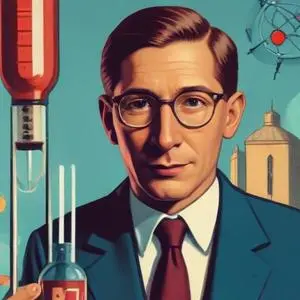
Discovered insulin and pioneered its use to treat diabetes, revolutionizing the treatment of the disease.
Frederick Banting, a Canadian pharmacologist, orthopedist, and field surgeon, is famously known for his groundbreaking discovery of insulin, a hormone that regulates blood sugar levels, alongside Charles Best in 1921. This monumental finding revolutionized the treatment of diabetes, earning Banting the Nobel Prize in Physiology or Medicine in 1923, at the tender age of 32, making him the youngest Nobel laureate in the field.
Born on November 14, 1891, in Essa, Ontario, Canada, Banting grew up in a financially stable family of British and Northern Irish origin. His childhood on the family's farmhouse instilled in him a strong sense of discipline and responsibility. Despite being the youngest of five children, Banting often felt excluded from his siblings, which may have contributed to his shy and asocial nature during his school days.
Banting's fascination with the human body led him to pursue a career in medicine. He earned his medical degree from the University of Toronto in 1916 and went on to work as an orthopedic surgeon. Inspired by the work of Scottish physiologist John Macleod, Banting began researching the pancreas and its role in diabetes. Collaborating with Charles Best, they successfully isolated insulin in Macleod's laboratory at the University of Toronto.
When Banting and Macleod received the 1923 Nobel Prize in Physiology or Medicine, Banting nobly shared the honors and award money with Best. The Canadian government, in recognition of his achievement, granted Banting a lifetime annuity to continue his work. This accolade not only solidified his position as a pioneer in the medical field but also paved the way for further research and breakthroughs.
Banting's personal life was marked by his dedication to his work and his country. During World War I, he served in the Canadian Army Medical Corps, where he was injured in 1918. He never married, devoting his life to scientific pursuits and public service. Banting was also an avid outdoorsman and loved to fly, even earning his pilot's license in 1929.
Banting's groundbreaking discovery of insulin has had a profound impact on modern medicine, saving countless lives and improving the quality of life for individuals with diabetes. His legacy extends beyond the medical field, inspiring generations of scientists, researchers, and medical professionals. Today, Banting is remembered as a trailblazer, a testament to the power of dedication, perseverance, and innovative thinking.
Sir Frederick Grant Banting's remarkable journey, marked by perseverance, innovation, and a passion for discovery, continues to inspire and motivate people around the world. His groundbreaking work has left an indelible mark on the world of medicine, ensuring that his legacy will endure for generations to come.
Born in 1899
Co-discoverer of insulin, a hormone that regulates blood sugar levels, revolutionizing the treatment of diabetes. This breakthrough has saved countless lives and improved the quality of life for millions.
Born in 1876
Discovered insulin and its role in diabetes, leading to a life-saving treatment for millions. Pioneering work in physiology and medicine paved the way for future breakthroughs.
Born in 1892
Co-discoverer of insulin, a hormone that regulates blood sugar levels, revolutionizing diabetes treatment. This groundbreaking finding has saved countless lives and improved quality of life for millions .
Born in 1924
Developed the charge-coupled device (CCD), a semiconductor technology used in digital cameras and other imaging devices, earning a Nobel Prize in Physics in 2009.
Born in 1886
A pioneering physiologist who discovered the production of heat in muscles, leading to a deeper understanding of muscle physiology, and was a prominent advocate for women's rights and education.
Born in 1893
A pioneering scientist who discovered deuterium, a heavy isotope of hydrogen, and later contributed to the discovery of many other elements, revolutionizing our understanding of the universe.
