


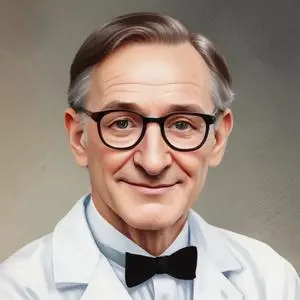
Developed the charge-coupled device (CCD), a semiconductor technology used in digital cameras and other imaging devices, earning a Nobel Prize in Physics in 2009.
Willard Boyle, a Canadian physicist, is renowned for co-inventing the charge-coupled device (CCD), an imaging semiconductor circuit that revolutionized photography and transformed the way we capture and perceive visuals. This groundbreaking innovation earned him the 2009 Nobel Prize in Physics, solidifying his status as a pioneer in the field of laser technology.
Born on August 19, 1924, in Amherst, Nova Scotia, Boyle was homeschooled by his mother until the age of 14. He then attended Montreal's Lower Canada College to complete his secondary education. Boyle pursued higher education at McGill University, where he earned his BSc in 1947, MSc in 1948, and PhD in 1950, with his education briefly interrupted by his service in the Royal Canadian Navy during World War II.
In 1953, Boyle joined Bell Labs, where he invented the first continuously operating ruby laser with Don Nelson in 1962 and was named on the first patent for a semiconductor injection laser.
In 1962, he became the director of Space Science and Exploratory Studies at Bellcomm, providing crucial support for the Apollo space program and playing a key role in selecting lunar landing sites.
Boyle returned to Bell Labs in 1964, contributing to the development of integrated circuits and further advancing the field of laser technology.
In addition to the Nobel Prize in Physics, Boyle was appointed a Companion of the Order of Canada, the highest level of the award, in 2010. This recognition solidified his position as one of Canada's most esteemed scientists and inventors.
Boyle's work embodies the spirit of innovation and exploration, demonstrating the power of human ingenuity in shaping the course of technology and our understanding of the world. His contributions to the field of laser technology and imaging continue to inspire future generations of scientists and engineers.
Throughout his life, Boyle remained committed to his work, driven by a passion for discovery and a desire to push the boundaries of human knowledge. His dedication earned him numerous accolades and recognition, cementing his legacy as a pioneering figure in the world of physics and technology.
The impact of Boyle's invention extends far beyond the realm of science, influencing various aspects of modern society. From photography and videography to medical imaging and astronomy, the CCD sensor has become an indispensable component, transforming the way we perceive and interact with the world around us.
Boyle's remarkable achievements are a testament to his innovative spirit and dedication to his craft. His contributions to the field of laser technology and imaging have had a profound impact, earning him a place among the most esteemed scientists of the 20th century.
Boyle's early interest in science was sparked by his father, a medical doctor.
During his time at Bell Labs, Boyle worked alongside other notable scientists, including Claude Shannon, the "father of information theory."
Willard Boyle's remarkable life and achievements serve as a testament to the power of human ingenuity and the importance of innovation. His legacy continues to inspire and influence generations of scientists, engineers, and photographers, solidifying his position as one of the most influential figures in the history of laser technology and imaging.
75 Years Old
A Nobel Prize-winning physicist who discovered the fractional quantum Hall effect, a phenomenon where electrons behave as quasiparticles with unusual properties. His work has greatly advanced our understanding of quantum mechanics.
87 Years Old
A Chinese-American physicist and academic who discovered the fractional quantum Hall effect, a phenomenon where electrons behave as quasiparticles with fractional charges. This groundbreaking work led to a deeper understanding of quantum mechanics.
Born in 1922
A Nobel Prize-winning physicist and mathematician who discovered the muon neutrino, a subatomic particle, and made significant contributions to our understanding of the universe. His work has far-reaching implications for particle physics and beyond.
95 Years Old
Discovered the J/? particle, a subatomic particle that led to a deeper understanding of the strong nuclear force and the structure of matter.
93 Years Old
A Nobel Prize-winning physicist who pioneered the electroweak force theory, a fundamental concept in modern particle physics. His work unified two of the four fundamental forces of nature, revolutionizing our understanding of the universe.
