


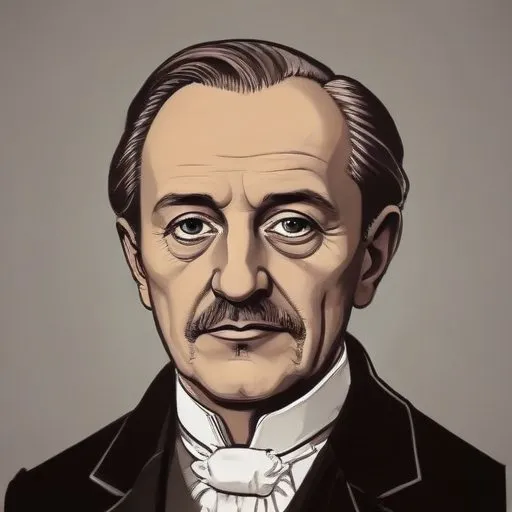
A 19th-century German literary figure, known for his influential novels, poetry, and plays that explored themes of realism, morality, and social commentary. His works remain significant in German literary history.
Friedrich Theodor Vischer, a prominent German novelist, poet, playwright, and writer on the philosophy of art, is best known for developing the concept of Die Tücke des Objekts, or "the spite of objects," a comic theory that inanimate objects conspire against humans. His influential novel, Auch Einer, showcases this concept and has remained a significant work in German literature.
Born on June 30, 1807, in Ludwigsburg, Germany, Vischer was the son of a clergyman. He received his education at the Tübinger Stift, a prestigious Protestant seminary, where he later became a professor of aesthetics and German literature.
Vischer's academic career was marked by controversy and innovation. In 1835, he became a Privatdozent in aesthetics and German literature at the University of Tübingen, and two years later, he was promoted to extraordinary professor. His inaugural address, which sparked controversy, led to his suspension by the Württemberg government for two years. During this period, he wrote the first two volumes of his monumental work, Aesthetik, oder Wissenschaft des Schönen (1846), which explored the philosophy of art.
The fourth and final volume of Aesthetik was published in 1857, and although it received criticism for its attempts to explain art using the Hegelian dialectic, it remains an important work in the field of aesthetics. Vischer's other notable works include Auch Einer, a novel that showcases his concept of Die Tücke des Objekts, and numerous plays and poems that demonstrated his versatility as a writer.
Vischer's philosophical contributions centered around his concept of Die Tücke des Objekts, which posits that inanimate objects have a tendency to thwart human plans and desires. This concept has been interpreted as a commentary on the human condition and the role of fate in our lives.
Vischer's philosophy was also influenced by the Hegelian dialectic, which he attempted to apply to the realm of art. Although his approach has been criticized, it reflects his efforts to understand the nature of beauty and the role of art in human experience.
Vischer's work has had a lasting impact on German literature and the philosophy of art. His concept of Die Tücke des Objekts has inspired subsequent writers and thinkers, and his Aesthetik remains a significant work in the field of aesthetics.
In addition to his literary and philosophical contributions, Vischer played an active role in the German political movement of 1848-1849, advocating for democratic reforms and national unity.
Friedrich Theodor Vischer's legacy is rooted in his contributions to German literature and the philosophy of art. Although his work has been subject to criticism, it remains an important part of the intellectual heritage of Germany and continues to inspire thinkers and writers today.
Born in 1790
Austrian actor and playwright who wrote and performed in popular folk plays, often incorporating magic and fantasy elements, and was a key figure in Vienna's theatrical scene. He is particularly known for his humorous and satirical works that poked fun at social issues of his time.
Born in 1801
Austrian actor and playwright who wrote satirical plays that critiqued social issues, known for his witty dialogue and clever characterizations.
Born in 1813
A 19th-century German literary figure who wrote influential plays and novels that explored social issues, and also critiqued the works of others. His works are still studied in German literature classes today.
Born in 1831
A 19th-century German literary realist, known for his vivid depictions of everyday life and social commentary through novels and paintings. His works offer a glimpse into the lives of ordinary people during the German Empire era.
Born in 1819
A 19th-century literary mastermind, renowned for crafting poignant novels and poetry that explored the human condition, particularly in the context of German society during the late 1800s.
