


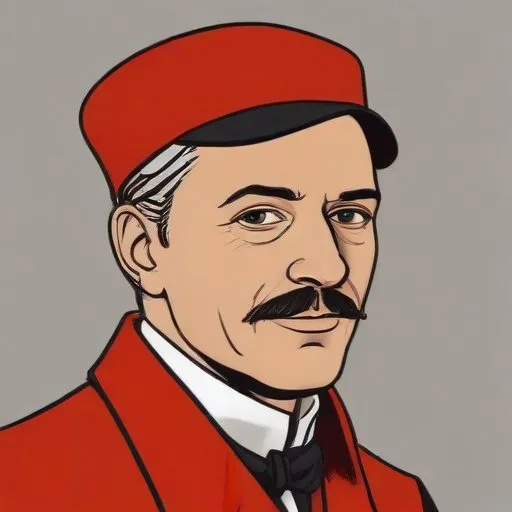
A 19th-century German literary realist, known for his vivid depictions of everyday life and social commentary through novels and paintings. His works offer a glimpse into the lives of ordinary people during the German Empire era.
Wilhelm Raabe, a renowned German novelist, is best known for his captivating works that delved into the intricacies of middle-class life, weaving a tapestry of vivid depictions that continue to enchant readers to this day. Through his writing, Raabe masterfully captured the essence of the German bourgeoisie, offering a glimpse into a world of contradictions, where tradition and modernity coexisted.
Born on September 8, 1831, in Eschershausen, Duchy of Brunswick (now in the Holzminden District), Raabe's life was marked by a passion for literature and philosophy. After attending gymnasia in Holzminden and Wolfenbüttel, he embarked on a journey to become a bookstore apprentice in Magdeburg in 1849. This experience not only honed his literary skills but also instilled in him a deep appreciation for the tales and folklore of his native Germany and beyond.
In 1854, Raabe's literary career took off when he published his first work, The Chronicle of Sparrow Lane, under the pseudonym Jakob Corvinus. This breakthrough novel, which chronicled life among the German bourgeoisie, quickly gained popularity, prompting Raabe to devote himself entirely to literary pursuits.
Raabe's writing spanned three distinct periods, each marked by a unique tone and style. His early works, characterized by a lighthearted touch, included novels like Dinner for One (1860) and The Children of Finkenrode (1859). The second period, influenced by the pessimism of philosopher Arthur Schopenhauer, yielded works like The Hunger Pastor (1864), Abu Telfan (1867), and The Squeaking Bog (1870). These three novels, often referred to as a trilogy, showcased Raabe's mastery of exploring the human condition.
Raabe's contributions to German literature were recognized during his lifetime. He received the highest honors, including the Grand Ducal Order of the Golden Lion, conferred upon him by the Grand Duke of Baden in 1896.
Wilhelm Raabe's literary legacy extends far beyond his own country's borders. His works have been widely translated, captivating readers worldwide with their nuanced portrayals of human relationships, societal norms, and the struggles of the German middle class. Raabe's influence can be seen in the works of later writers, such as Thomas Mann and Hermann Hesse, who drew inspiration from his pioneering spirit and literary prowess.
Raabe's personal life was marked by periods of travel and introspection. He lived in various cities, including Berlin, Stuttgart, and Wolfenbüttel, before returning to his hometown of Brunswick. Raabe passed away on November 15, 1910, leaving behind a rich literary heritage that continues to enrich the lives of readers and inspire future generations of writers.
Raabe's words of wisdom continue to resonate with readers today:
Wilhelm Raabe's life and works serve as a testament to the power of literature to capture the essence of humanity. Through his writing, he offered a window into the world of the German bourgeoisie, revealing the complexities and contradictions that underlie human relationships. As a writer, philosopher, and observer of life, Raabe's legacy continues to inspire and captivate readers, ensuring his place in the annals of literary history.
Born in 1819
A 19th-century literary mastermind, renowned for crafting poignant novels and poetry that explored the human condition, particularly in the context of German society during the late 1800s.
Born in 1819
A 19th-century literary mastermind, celebrated for his vivid storytelling and poetic flair, particularly in his novel "Green Henry", which explores the human condition. His works are considered a cornerstone of Swiss literature.
Born in 1830
A German literary mastermind, renowned for his poetic and dramatic works that explored the human condition, earning him the Nobel Prize in Literature in 1910.
