


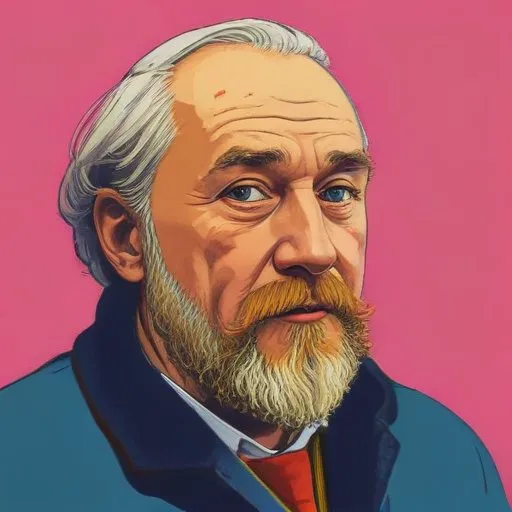
A Norwegian painter celebrated for capturing the essence of everyday life and landscapes through impressionist brushstrokes, evoking a sense of serenity and intimacy.
Frits Thaulow, a renowned Norwegian painter, is best known for his captivating depictions of landscapes, seascapes, and cityscapes, suffused with a unique sense of light and color. His works, characterized by their naturalistic and impressionistic style, capture the essence of the environments he painted, transporting viewers to the picturesque towns and villages of Norway, France, and beyond.
Born on October 20, 1847, in Christiania (now Oslo), Norway, Thaulow was the son of a wealthy chemist, Harald Conrad Thaulow. He was educated at the Academy of Art in Copenhagen from 1870 to 1872, and later studied with Hans Gude at the Baden School of Art in Karlsruhe from 1873 to 1875.
In 1879, Thaulow traveled to Skagen, a small fishing village in northern Jutland, Denmark, where he met fellow artist Christian Krohg. This trip marked a turning point in Thaulow's career, as he began to focus on capturing the light and color of the Norwegian landscape. His time in Skagen also saw the development of his signature naturalistic and impressionistic style, which would become a hallmark of his work.
After returning to Norway in 1880, Thaulow became a leading figure in the Norwegian art scene, alongside Christian Krohg and Erik Werenskiold. He played a crucial role in establishing the first National Art Exhibit, also known as Høstutstillingen or Autumn Exhibit, in 1882. This exhibit provided a platform for Norwegian artists to showcase their work, and Thaulow's contributions helped to shape the country's artistic identity.
In 1892, Thaulow moved to France, where he would spend the remainder of his life. Although he initially struggled to adapt to the cityscapes of Paris, he soon discovered the charm of smaller towns such as Montreuil-sur-Mer, Dieppe, and Quimperle in Brittany. These towns inspired some of his most iconic works, including "A Village Street in France," which showcased his mastery of light and color.
Thaulow's personal life was marked by a deep connection with his wife, Alexandra, and their friendships with fellow artists, including Charles Conder and Aubrey Beardsley. His legacy extends beyond his own works, as he played a significant role in shaping the development of Norwegian art and influencing future generations of artists.
Frits Thaulow's contribution to Norwegian art and his innovative approach to landscape painting have left a lasting impact on the art world. His works continue to inspire artists and captivate audiences, offering a glimpse into the beauty and charm of Norway and France during the late 19th century.
Frits Thaulow's life and art are a testament to the power of creativity and innovation. Through his unique style and captivating works, he has left an indelible mark on the world of art, and his legacy will continue to inspire generations to come.
Born in 1840
A founder of Impressionism, capturing fleeting light and color in dreamy landscapes and water scenes, revolutionizing modern art.
Born in 1841
A pioneer of Impressionism, creating vibrant, intimate portraits and landscapes that capture the beauty of everyday life. His works evoke a sense of joy and warmth, celebrating the human experience.
Born in 1830
A Danish-French Impressionist painter who captured the beauty of landscapes and cityscapes with vivid colors and bold brushstrokes, influencing the development of modern art.
Born in 1863
A Norwegian painter who created iconic, emotionally charged works that explored the human experience, including the famous piece "The Scream".
Born in 1869
A pioneering artist who revolutionized modern art with bold, expressive, and colorful works that blurred the lines between painting and sculpture, creating a new language of form and color.
Born in 1839
A post-Impressionist pioneer, he's famous for his still-life compositions and landscapes that laid the groundwork for Cubism, influencing 20th-century art.
Born in 1853
A post-Impressionist master, renowned for vibrant, expressive paintings of landscapes, still lifes, and portraits, characterized by bold colors and emotional depth.
Born in 1848
A post-Impressionist master who broke away from traditional European art forms, creating bold, expressive, and emotive works that explored the human experience and the beauty of the natural world.
