


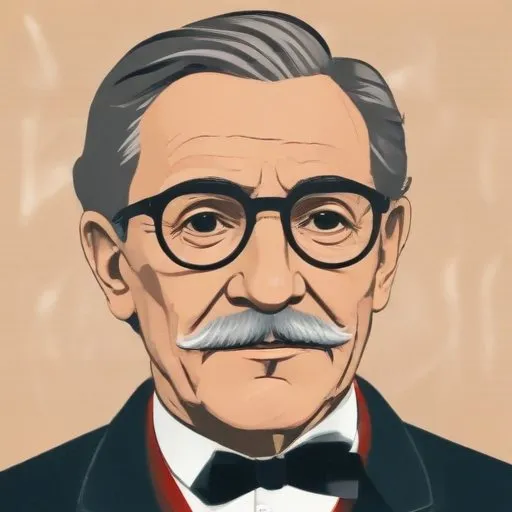
Developed spot tests for chemical analysis, revolutionizing forensic science and crime scene investigation.
Fritz Feigl, a Jewish Austrian-born chemist, is renowned for developing the spot analysis technique, a simple and efficient method that revolutionized chemical analysis. This innovative approach allows for the execution of analytical assays using only a few drops of a chemical solution, preferably on a piece of filter paper, without the need for sophisticated instrumentation.
Fritz Feigl was born on May 15, 1891, in Vienna, Austria. His academic pursuits were interrupted by his military service in World War I, but he eventually received his Ph.D. in 1920 under the guidance of Wilhelm Schlenk. Feigl's academic career continued to flourish, and he became a professor at the University of Vienna after his habilitation in 1928.
Following the Nazi occupation of Austria in 1938, Feigl was forced to retire and flee his homeland. He made his way to Belgium, where he worked briefly before being imprisoned in a concentration camp during the occupation. Feigl managed to escape to Portugal and eventually settled in Brazil in 1940. He became a Brazilian citizen in 1944 and began teaching at the Federal University of Rio de Janeiro.
Feigl's most significant contribution to the field of chemistry is the development of spot analysis, also known as spot testing. This technique has numerous practical applications, including detecting contaminants in food and water. One notable example is Feigl's simple test to determine if fish consumed by Amazonian populations are contaminated with lead. This test has been instrumental in improving public health in these communities.
Feigl's work on spot analysis led to the development of luminol, a substance used by forensic investigators to detect the presence of blood, even after a crime scene has been cleaned.
Feigl was a prolific writer and published several books on chemistry, including:
Feigl's groundbreaking work was recognized with several prestigious awards, including:
In 1962, the Chemical Society of Midland sponsored a symposium in Feigl's honor, which was attended by 500 scientists from 24 countries. This tribute is a testament to the significance of Feigl's contributions to the field of chemistry.
Fritz Feigl's legacy extends beyond his scientific achievements. His life story is a testament to the resilience of the human spirit and the power of innovation in the face of adversity. His work continues to inspire new generations of scientists and has had a profound impact on the field of chemistry.
Born in 1835
German chemist and Nobel laureate who synthesized barbituric acid and developed the theory of organic dyes, revolutionizing the textile industry. His work laid the foundation for modern dye chemistry.
Born in 1868
Developed a process to synthesize ammonia, revolutionizing agriculture and warfare, and was awarded the Nobel Prize in Chemistry in 1918.
Born in 1881
A leading figure in Austrian socialism, he played a key role in shaping the country's post-WWI government and was a prominent advocate for democratic socialism. His writings on Marxism and nationalism remain influential.
Born in 1898
Developed groundbreaking catalysts that revolutionized the production of plastics and led to the creation of new materials, earning a Nobel Prize in Chemistry.
Born in 1903
Developed groundbreaking synthetic polymers, revolutionizing plastics and fibers, and was awarded the Nobel Prize in Chemistry in 1963.
