


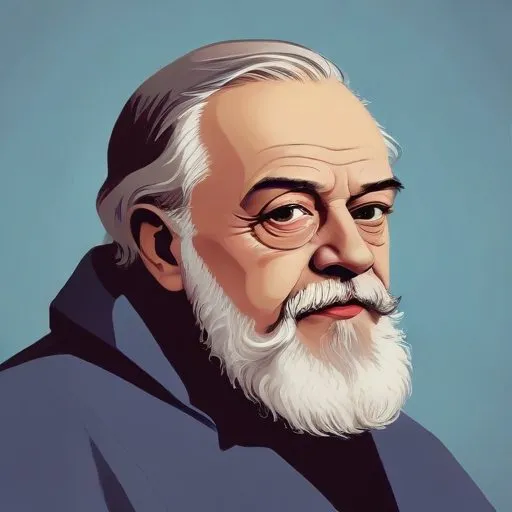
Developed the theory of the rotating magnetic field, a crucial concept in the design of alternating current (AC) systems, revolutionizing the way electricity is transmitted and used.
Galileo Ferraris, an Italian physicist and electrical engineer, is renowned for his groundbreaking work on the development of alternating current (AC) power systems and the invention of the induction motor. His pioneering research and innovations in the field of electrical engineering paved the way for the widespread adoption of AC power, revolutionizing the way electricity is generated, transmitted, and utilized.
Born on October 31, 1847, in Livorno Vercellese, Kingdom of Sardinia, Ferraris demonstrated a keen interest in science and technology from an early age. He pursued his passion for engineering, earning a master's degree in engineering and subsequently becoming an assistant of technical physics at the Regal Italian Industrial Museum.
In 1885, Ferraris embarked on a journey of independent research, focusing on the rotary magnetic field. His experiments with asynchronous electric motors led to the development of an alternator, which could convert mechanical rotating power into electric power as alternating current. This innovation was a crucial stepping stone in the evolution of AC power systems.
On March 11, 1888, Ferraris published his research in a paper to the Royal Academy of Sciences in Turin, detailing his work on polyphase alternators. These alternators, capable of producing multiple sinusoidal currents displaced from each other in phase, relied on a rotating magnetic field for their operation. The invention of the polyphase alternator marked a significant milestone in the history of electrification, enabling the efficient transmission of power over long distances.
Ferraris' work on polyphase alternators led to the development of the power transformer, which further facilitated the transmission of AC power. This "Ferraris effect" enabled the widespread adoption of AC power systems, replacing direct current (DC) systems and paving the way for the modern electrical grid.
Ferraris' contributions to the field of electrical engineering have had a profound impact on modern society. His work on AC power systems has enabled the efficient transmission of power over long distances, facilitating the widespread adoption of electricity in industries, homes, and transportation. The Ferraris effect has also inspired numerous innovations in related fields, including the development of hydroelectric power plants and high-voltage transmission lines.
Ferraris' pioneering work was recognized during his lifetime, with many newspapers hailing his inventions as among the greatest of all ages. Although he never patented his work, his legacy continues to inspire generations of engineers, scientists, and innovators.
Galileo Ferraris' remarkable legacy continues to shape the world of electrical engineering, inspiring new generations of innovators and engineers to push the boundaries of what is possible.
Born in 1856
A pioneering engineer who harnessed the power of alternating current (AC) to transform the world's electrical systems, and is credited with developing groundbreaking technologies like radio communication and X-ray imaging.
Born in 1847
A pioneer in innovation, credited with developing groundbreaking inventions that revolutionized the way people live and communicate, including the light bulb and phonograph.
Born in 1874
Developer of the first practical wireless telegraph, pioneering radio communication and earning a Nobel Prize in Physics. Known for revolutionizing long-distance communication.
Born in 1857
A pioneer in the field of electromagnetism, he discovered radio waves and proved James Clerk Maxwell's theories, paving the way for modern wireless communication. His experiments led to the development of radio, television, and mobile phones.
Born in 1831
Developed groundbreaking theories that unified electricity and magnetism, and predicted the existence of radio waves, revolutionizing our understanding of the physical world.
Born in 1791
Pioneering scientist who discovered electromagnetic induction, formulated the laws of electrolysis, and invented the first electrical generator, revolutionizing our understanding of electricity and its applications.
Born in 1775
A pioneer in the field of electromagnetism, he formulated fundamental laws that describe the relationship between electric currents and magnetic fields. His work laid the foundation for many modern technologies, including electric motors and generators.
Born in 1821
A 19th-century physician and physicist who made significant contributions to the fields of electromagnetism, thermodynamics, and the physiology of human perception, particularly in the study of vision and hearing.
