


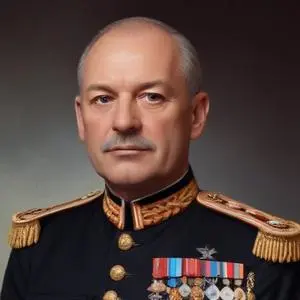
A Prussian military leader who played a crucial role in defeating Napoleon at the Battle of Waterloo, cementing his legacy as a hero of the Napoleonic Wars.
Gebhard Leberecht von Blücher, also known as the Prince of Wahlstatt, is renowned for his bravery and tactical genius in the Napoleonic Wars, leading the Prussian Army to victory against the French Empire at the Battle of the Nations in 1813 and the Battle of Waterloo in 1815.
Born on December 21, 1742, in Rostock, Germany, Blücher was the son of a retired army captain. He began his military career in 1758 as a hussar in the Swedish Army, but was captured by the Prussians in 1760 during the Pomeranian Campaign. He thereafter joined the Prussian Army, serving as a hussar officer during the remainder of the Seven Years' War.
In 1773, Blücher was forced to resign from the Prussian Army due to insubordination, and he spent several years working as a farmer. However, with the death of Frederick the Great in 1786, Blücher was reinstated and promoted to colonel, marking the beginning of his rise to prominence in the military.
During the French Revolutionary Wars, Blücher distinguished himself as a capable and courageous military leader, earning promotions to major general in 1794 and lieutenant general in 1801. He commanded the cavalry corps during the Napoleonic Wars in 1806, demonstrating his tactical prowess and earning the respect of his comrades.
In 1813, at the age of 71, Blücher returned to active service, leading the Prussian Army against Napoleon's forces at the Battle of the Nations in Leipzig. His victory at the Battle of Katzbach and his bravery at the Battle of the Nations earned him the title of Prince of Wahlstatt and recognition as a national hero in Germany.
In 1815, Blücher commanded the Prussian Army of the Lower Rhine, coordinating with the British and Allied forces under the Duke of Wellington to defeat Napoleon at the Battle of Waterloo. This decisive victory marked the final defeat of Napoleon and cemented Blücher's place in history as a master strategist and military leader.
For his outstanding military service, Blücher was granted the title of Field Marshal, and his name became synonymous with bravery, tactical genius, and German patriotism. He died on September 12, 1819, leaving behind a legacy as one of the most celebrated military leaders in Prussian history.
"ForeWARnening is the essence of victory."
"A good cavalry officer must have a good horse, a good sword, and a good stomach."
Blücher's victories against Napoleon marked a turning point in European history, contributing to the eventual downfall of the French Empire and the rise of Germany as a major power. His military campaigns and strategic genius have been studied by military leaders and historians for centuries, cementing his place as one of the most important figures of the Napoleonic Wars.
Blücher's legacy extends beyond the military sphere, influencing German culture and identity. He is remembered as a national hero, and his name is still celebrated in Germany today. His bravery and tactical genius have inspired countless individuals, and his impact on European history continues to be felt.
Gebhard Leberecht von Blücher was a true military legend, whose bravery, strategic genius, and unwavering dedication to his country have left an indelible mark on history. His legacy serves as a testament to the power of courage and determination, inspiring generations to come.
Born in 1769
A French military leader who rose to prominence during the French Revolution and became Emperor of France, known for his military conquests and reorganization of Europe. He is also famous for his Napoleonic Code, which remains a foundation of modern law.
Born in 1712
Prussian king who ruled with Enlightenment values, promoting arts, education, and religious tolerance, while also being a skilled military strategist and expanding his kingdom through wars.
Born in 1769
A renowned military leader who defeated Napoleon at the Battle of Waterloo, and later served as Prime Minister of the United Kingdom, shaping the country's politics and history.
Born in 1755
A pioneering military reformer who modernized the Prussian army and played a key role in the Napoleonic Wars, known for his innovative tactics and strategic thinking.
