


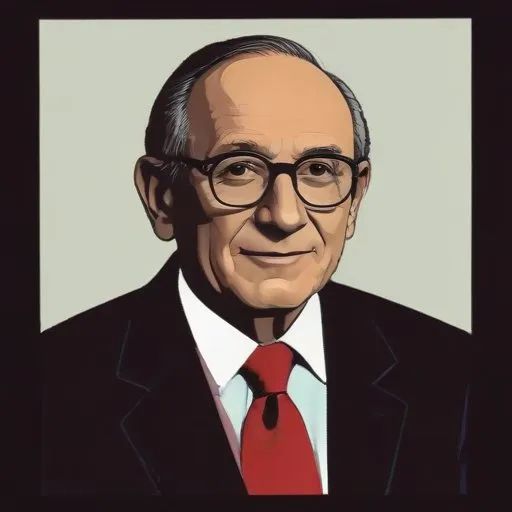
Developed influential trade models and theories on international economics, particularly on the effects of globalization and outsourcing. 22
Gene Grossman is renowned for his groundbreaking research on the relationship between economic growth and international trade, as well as the political economy of trade policy. As the Jacob Viner Professor of International Economics at Princeton University, Grossman has made significant contributions to the field, particularly in understanding the environmental Kuznets curve.
Born on December 11, 1955, in New York, Grossman pursued his undergraduate degree in Economics from Yale University, graduating in 1976. He furthered his academic pursuits at the Massachusetts Institute of Technology (MIT), earning his Ph.D. in Economics in 1980.
Grossman's academic career took off in 1980 when he became an assistant professor at Princeton University. He rose through the ranks to become a full professor of economics in 1988. Grossman's most notable collaborations are with Harvard professor Elhanan Helpman, with whom he co-authored three influential books: Innovation and Growth in the Global Economy, Special Interest Politics, and Interest Groups and Trade Policy.
Grossman's contributions to the field of international trade and economics have been recognized with numerous awards and honors. In 2009, he received an honorary doctorate in Economics from the University of St. Gallen. In 2015, he was awarded the Onassis Prize for International Trade, and in 2016, he received an honorary doctorate in Economics from the University of Minho.
Grossman is married to Jean Baldwin Grossman, a faculty member in the Princeton School of Public and International Affairs. He has two children and is a member of the American Academy of Arts and Sciences, elected in 1997.
Gene Grossman's work has significantly influenced the field of international trade and economics, shaping our understanding of the complex relationships between economic growth, trade, and environmental policies. His contributions continue to inspire future generations of economists and policymakers, ensuring a lasting legacy in the world of economics.
73 Years Old
A Nobel Prize-winning economist and academic who has made significant contributions to the field of international trade and economic geography, and is also a prominent columnist and author.
83 Years Old
A Nobel Prize-winning economist and academic who has made significant contributions to the field of economics, particularly in the areas of information economics and globalization.
93 Years Old
A renowned economist and philosopher who has made significant contributions to welfare economics, social choice theory, and development economics, and is known for his work on poverty, famine, and human development.
95 Years Old
A pioneer in applying economic theory to social issues, he's most known for his work on human capital, crime and punishment, and the economics of the family.
Born in 1912
A Nobel Prize-winning economist who championed free market capitalism and limited government intervention, known for his advocacy of laissez-faire economics and influential writings on monetary policy.
89 Years Old
Developed the theory of rational expectations, which revolutionized macroeconomics by showing how people's expectations of future events affect current economic decisions.
87 Years Old
A Nobel Prize-winning economist and academic who developed the Efficient Market Hypothesis, which revolutionized our understanding of stock markets and investments.
