


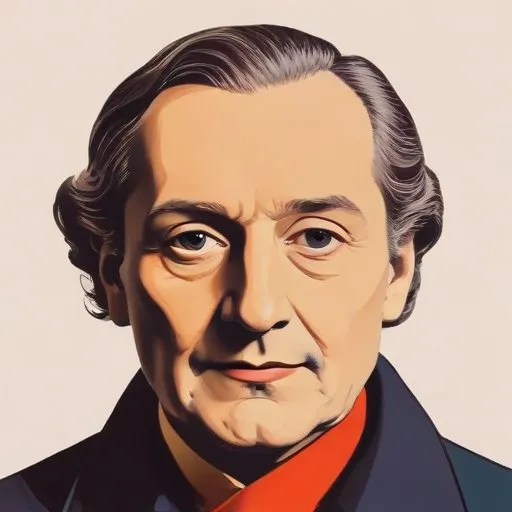
A German poet and philosopher who wrote influential works on mysticism, pantheism, and the relationship between Christianity and philosophy, exploring the nature of God and humanity.
Georg Friedrich Daumer, a German poet and philosopher, is renowned for his radical ideas on religion, philosophy, and love. He is best known for his work "Religion des neuen Weltalters" (Religion of the New Age), which sparked intense debate and criticism, including a scathing review by Karl Marx and Frederick Engels.
Born on March 5, 1800, in Nuremberg, Germany, Daumer was educated at the gymnasium in his native city, where he was heavily influenced by the prominent philosopher Hegel. He later pursued theology at the University of Erlangen, but soon switched to philosophy, which became his true passion.
Daumer's philosophical ideas were shaped by his exposure to Pietism during his time at Erlangen. However, he gradually became skeptical of Christianity and began to develop his own pantheistic beliefs. He advocated for a new religion of love and peace, which he outlined in his controversial work "Religion des neuen Weltalters".
Daumer's literary career spanned several decades, during which he published numerous works that showcased his antitheological views. Some of his notable works include:
Daumer's unorthodox ideas and criticism of Christianity sparked heated debates and controversies during his time. Despite this, his work continues to inspire discussions on religion, philosophy, and social reform. His emphasis on love and peace as the foundation of a new religion has influenced thinkers and philosophers to this day.
Daumer's work was not without its critics. Karl Marx and Frederick Engels, two prominent thinkers of the time, wrote a scathing review of "Religion des neuen Weltalters", criticizing Daumer's theory of history and his lack of understanding of class struggle.
In 1858, Daumer made a surprise conversion to Catholicism, which marked a significant shift in his beliefs and writing style. He became a zealous defender of the Catholic faith, which was a far cry from his earlier pantheistic views.
Georg Friedrich Daumer's legacy lies in his fearless questioning of established theological and philosophical norms. His work continues to inspire and provoke thought, making him a significant figure in the history of German philosophy and literature.
Through his life and work, Daumer demonstrated an unwavering commitment to his ideals, even in the face of controversy and criticism. His story serves as a testament to the power of courage and conviction in shaping our understanding of the world and our place in it.
Born in 1759
A renowned poet and playwright who crafted influential works that explored the human condition, morality, and the struggle for freedom, leaving a lasting impact on German literature.
Born in 1749
A German literary giant who penned iconic works like "Faust" and "The Sorrows of Young Werther", shaping the Romantic movement and influencing countless writers.
Born in 1724
Developed influential philosophical frameworks, such as the Critique of Pure Reason, that shaped modern Western thought on ethics, morality, and human understanding.
Born in 1772
A key figure in German Romanticism, this poet and philosopher explored the mysteries of nature, the human condition, and the power of the imagination through lyrical and dreamlike writings.
Born in 1788
A pessimistic philosopher who wrote about the human condition, emphasizing the struggles and sufferings of life, and is famous for his concept of the "will to life".
Born in 1770
A German philosopher and academic who developed a comprehensive and systematic philosophy that emphasized the unity of all things and the dialectical process of thesis, antithesis, and synthesis. His ideas have had a profound impact on modern thought, influencing fields such as philosophy, politics, and art.
Born in 1762
A German philosopher and academic who developed the concept of German idealism, emphasizing the role of the individual and the nation in shaping reality. He's known for his influence on German philosophy and the development of existentialism.
