


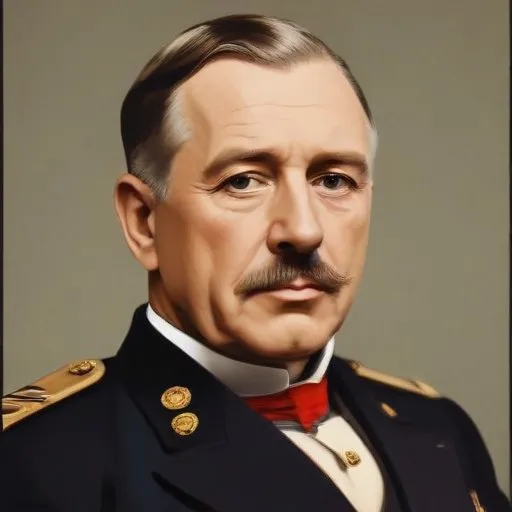
A British army officer who pursued entomology, discovering and describing numerous insect species, particularly butterflies and moths. His contributions significantly advanced the field of lepidoptery.
George Frederick Leycester Marshall is best known for his groundbreaking work in the field of ornithology and lepidoptery, having described several new species of butterflies and discovering the whitetailed iora, commonly referred to as Marshalls iIora. As a colonel in the Indian Army, Marshall's passion for natural history led him to author several seminal works on the birds and butterflies of India, Burmah, and Ceylon.
Born on March 27, 1843, in Bridgnorth, Salop, Marshall was the son of William Marshall, a clergyman, and his wife Louisa Sophia. He was also the brother of C. H. T. Marshall and uncle of Guy Anstruther Knox Marshall. Marshall's early life was marked by a deep fascination with the natural world, which would eventually become the driving force behind his remarkable contributions to science.
Marshall's most notable work is perhaps his trilogy on The Butterflies of India, Burmah and Ceylon, a comprehensive and meticulously researched series of volumes that remains a cornerstone of lepidoptery to this day. The first volume, published in 1883, was co-authored with Lionel de Nicville, while the subsequent volumes, published in 1886 and 1890, cemented Marshall's reputation as a leading authority on the subject.
Marshall's work on the birds of India was equally groundbreaking. His 1877 publication, Birds Nesting in India, provided a detailed calendar of the breeding seasons and habits of Indian birds, offering a unique glimpse into the country's rich avifaunal diversity. This work not only solidified Marshall's position as a respected ornithologist but also demonstrated his commitment to sharing his knowledge with a wider audience.
Marshall married Elizabeth Huntley Muir in 1874, and the couple had one son, George Leycester Knox, who sadly passed away at a young age in 1883. Marshall was made a Companion of the Order of the Indian Empire (CIE) in the 1893 New Year Honours, a testament to his outstanding contributions to the fields of natural history and science.
George Frederick Leycester Marshall's legacy extends far beyond his remarkable contributions to the fields of ornithology and lepidoptery. His work continues to inspire generations of scientists, naturalists, and enthusiasts, offering a window into the rich biodiversity of the Indian subcontinent. Marshall's dedication to sharing his knowledge and passion for the natural world has left an indelible mark on our understanding of the world around us.
Born in 1825
A British explorer who traveled to the Amazon rainforest and discovered over 8,000 species, including butterflies, beetles, and birds, and is known for his theory of mimicry in nature.
Born in 1823
A pioneering naturalist who discovered evolution through natural selection, independently of Charles Darwin, and contributed significantly to the field of biogeography.
Born in 1809
Developed the theory of evolution through natural selection, revolutionizing our understanding of life on Earth. This groundbreaking idea transformed the fields of biology, ecology, and beyond.
Born in 1817
A renowned botanist and explorer who contributed significantly to the discovery and classification of numerous plant species, particularly in the Himalayas and Antarctica. His work laid the foundation for modern botanical research.
Born in 1810
A pioneering botanist who contributed significantly to the development of American botany, particularly in the fields of plant classification and evolution.
Born in 1796
A British botanist and geologist who taught Charles Darwin at Cambridge University and inspired his love of natural history, leading to Darwin's voyage on the HMS Beagle. He was a pioneer in the field of botany, particularly in the study of algae.
