


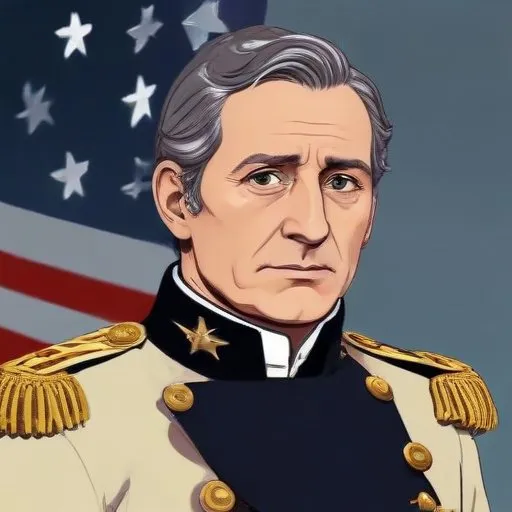
Union general who played a crucial role in the American Civil War, particularly in the Western Theater, earning the nickname "The Rock of Chickamauga" for his defensive stand against Confederate forces.
General George Henry Thomas was a prominent figure in the American Civil War, earning his reputation as a steadfast and reliable commander in the Union Army. His most notable achievement was his defense at the Battle of Chickamauga, where he single-handedly saved the Union Army from complete defeat, earning him the nickname "The Rock of Chickamauga."
Born on July 31, 1816, in Newsoms Depot, Southampton County, Virginia, Thomas was the son of John Thomas, a Welsh descendant, and Elizabeth Rochelle Thomas, a French Huguenot immigrant. He was the third of six children, and his family's strong values and work ethic instilled in him a sense of duty and responsibility that would shape his future career.
Thomas graduated from the United States Military Academy at West Point in 1840, ranking 12th out of 42. He served in the Mexican-American War, where he earned several promotions and gained valuable experience. Despite being a Virginian, Thomas remained loyal to the Union when the American Civil War broke out, refusing to join the Confederacy.
Thomas' military career was marked by several significant victories, including the Battle of Mill Springs in Kentucky, where he earned one of the first Union victories of the war. He also played crucial roles at Perryville and Stones River, showcasing his tactical prowess and leadership abilities.
The Battle of Chickamauga in 1863 was a turning point in Thomas' career. Despite being vastly outnumbered, he held off the Confederate Army, allowing the Union forces to regroup and maintain control of the surrounding area. This heroic defense earned him his famous nickname, "The Rock of Chickamauga."
After the war, Thomas continued to serve in the military, eventually becoming a major general. He remained humble and unassuming, refusing to seek promotion or recognition, and instead focused on his duties and responsibilities. Thomas passed away on March 28, 1870, leaving behind a legacy as one of the most reliable and effective commanders of the Civil War.
Thomas' commitment to duty and his willingness to put the needs of others before his own reflect his strong moral character. He demonstrated that true leadership is not about seeking glory or recognition, but about serving others and doing what is right, even in the face of adversity.
Thomas' legacy extends beyond his military career, inspiring future generations with his commitment to duty and his unwavering dedication to what he believed was right. His selflessness and humility serve as a reminder of the importance of putting the needs of others before one's own, making him a role model for leaders and individuals alike.
Born in 1822
Led the Union Army to victory in the Civil War and later became President, known for issuing the Emancipation Proclamation and strengthening federal authority.
Born in 1820
A renowned Union general during the American Civil War, he's infamous for his scorched earth tactics and march through the Confederacy, leaving destruction in his wake.
Born in 1824
A Union general during the American Civil War, known for his distinctive sideburns and leading the Army of the Potomac to a disastrous defeat at the Battle of Fredericksburg.
Born in 1831
A Confederate general during the American Civil War, known for his bravery and aggressive tactics, but also criticized for his reckless decisions that led to devastating defeats.
Born in 1821
A Confederate general during the American Civil War, later serving as a diplomat and ambassador to Turkey, known for his military strategies and post-war reconciliation efforts.
Born in 1826
A Union general during the American Civil War, he's infamous for his cautious tactics and disagreements with President Lincoln, later becoming a governor of New Jersey.
