


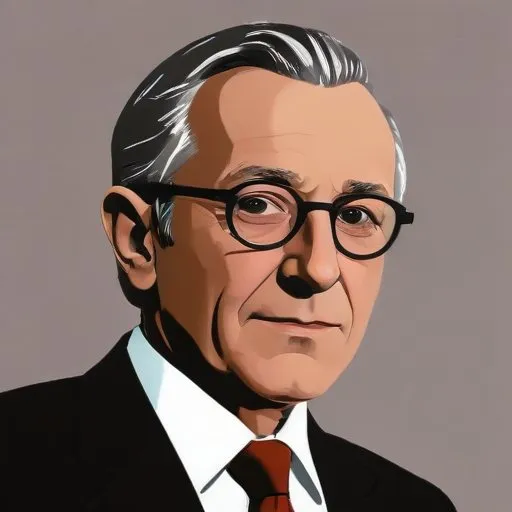
A renowned philosopher, author, and critic who explored the intersection of language, culture, and morality, and is known for his provocative and erudite writings on the human condition.
George Steiner, a Franco-American literary critic, essayist, philosopher, novelist, and educator, was renowned for his profound writings on the intricate relationships between language, literature, and society. His works explored the impact of the Holocaust, making him a prominent figure in modern literary circles.
Born on April 23, 1929, in Paris, to Viennese Jewish parents Else and Frederick Georg Steiner, George was raised in a multilingual environment. His father, a senior lawyer and investment banker, had moved the family from Austria to France five years before George's birth to escape the growing threat of anti-Semitism. This early exposure to different languages and cultures would later shape Steiner's unique perspective on literature and society.
Steiner's academic career spanned several prestigious institutions, including the University of Geneva, University of Oxford, Harvard University, and Churchill College, Cambridge, where he held professorships in English and Comparative Literature, and Poetry. His notable works include:
Steiner's work was deeply rooted in his philosophical beliefs about the power of language and its impact on human understanding. He believed that language was not just a means of communication but a fundamental aspect of human experience. His writings often explored the tension between language, culture, and identity, and he was critical of the limitations of language in conveying human experience.
Steiner's works have had a significant impact on modern literary thought, influencing scholars and writers such as A.S. Byatt, who described him as a "late, late, late Renaissance man... a European metaphysician with an instinct for the driving ideas of our time." His lectures were known for their prophetic and doom-laden tone, earning him a reputation as a magnificent lecturer.
Steiner's life was marked by significant personal milestones, including his family's escape from anti-Semitism in Austria and his later experiences as a Jewish intellectual in post-war Europe. These events deeply influenced his writing and shaped his perspective on the human condition.
Steiner's writings are filled with memorable quotes and sayings that capture the essence of his philosophical outlook. One of his most famous quotes is: "The task of the poet is to make his language a forest where others can wander."
Steiner's contributions to literary criticism, philosophy, and education have left a lasting legacy in the academic community. His works continue to inspire scholars, writers, and educators, and his ideas on language and literature remain relevant in today's intellectual landscape.
Steiner received numerous awards and honors for his contributions to literature and education, including the Prix Mondial Cino Del Duca (1974) and the Truman Capote Lifetime Achievement Award (2003).
George Steiner passed away on February 3, 2020, leaving behind a rich legacy of intellectual inquiry and literary achievement. His works continue to inspire and challenge readers, ensuring his place as one of the most important literary minds of the 20th century.
Born in 1905
Existentialist philosopher and playwright who argued that humans have complete freedom to choose their actions and create their own meaning in life, influencing modern thought on morality and individual responsibility.
Born in 1889
A German philosopher and academic who explored the meaning of existence, time, and human existence, influencing 20th-century philosophy with his concept of "Being-in-the-world".
Born in 1906
A Lithuanian-French philosopher who developed the concept of "ethics as first philosophy," emphasizing the importance of responsibility towards others and the face-to-face encounter. His work has influenced contemporary thought on morality, justice, and human rights.
Born in 1906
A 20th-century philosopher and theorist who explored the nature of power, politics, and humanity, particularly in the context of totalitarianism and the Holocaust.
Born in 1903
A critical theorist who critiqued modern society, culture, and capitalism, arguing that they perpetuate inequality and stifle individual freedom. His work influenced many fields, from sociology to musicology.
Born in 1892
A German philosopher and critic who analyzed the impact of technology on society, particularly in regards to art and culture, and is famous for his concept of "aura" in the age of mechanical reproduction.
96 Years Old
A pioneer of poststructuralism, deconstructing traditional notions of meaning and challenging Western philosophy's core assumptions. His work redefined the way we think about language, culture, and identity.
99 Years Old
A French historian and philosopher who critiqued power structures and social norms, arguing that knowledge and truth are shaped by those in power. He's known for his concepts of power, discipline, and surveillance.
