


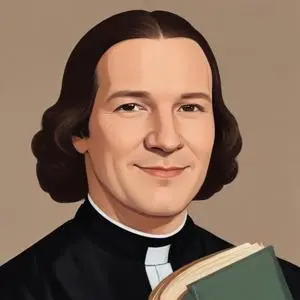
A charismatic Anglican priest who led a spiritual revival in 18th-century England and America, preaching to massive crowds and influencing the development of evangelical Christianity.
George Whitefield, the renowned English Anglican minister and preacher, left an indelible mark on the spiritual landscape of the 18th century. Known as one of the founders of Methodism and the evangelical movement, his impassioned sermons and tireless evangelism sparked a wave of spiritual revival that resonated throughout the British Empire.
Born on December 27, 1714, at the Bell Inn, Southgate Street, Gloucester, Whitefield was the fifth son and seventh child of Thomas Whitefield and Elizabeth Edwards. Following his father's untimely death at the age of two, Whitefield assisted his mother in running the inn, where he developed his passion for acting and storytelling.
Education played a pivotal role in shaping Whitefield's future. He attended The Crypt School in Gloucester and later matriculated at Pembroke College, Oxford, in 1732. It was during his time at Oxford that he joined the Holy Club, a group of students committed to spiritual growth and service, where he met his lifelong friends and collaborators, John and Charles Wesley.
Unlike his contemporaries, Whitefield shunned the traditional parish ministry, opting instead for an itinerant preaching style that took him to the streets, fields, and marketplaces of England and beyond. His unorthodox approach, which emphasized emotional appeal and personal evangelism, drew crowds and sparked controversies.
In 1740, Whitefield traveled to British North America, where he preached a series of Christian revivals that became part of the First Great Awakening. His charismatic presence, coupled with his mastery of storytelling and drama, enabled him to captivate audiences, often leaving them in tears, and inspiring many to recommit to their faith.
Whitefield's Calvinist leanings set him apart from his Wesleyan friends, who espoused Arminianism. His conviction in predestination and the sovereignty of God permeated his sermons, which emphasized the need for personal conversion and the importance of evangelism.
Whitefield's impact on modern society extends far beyond his own lifetime. He played a significant role in shaping the course of American Christianity, inspiring a new generation of evangelists, including Jonathan Edwards and Benjamin Franklin. His legacy can be seen in the countless denominations and evangelical movements that emerged in the centuries following.
"I am willing to go to prison, to be burned, to be executed, as the providence of God shall allow, in order to maintain the truth of God."
"O, the comfort of the Holy Ghost! What a sweet anointing it is! It is like oil, it is like balm; it is like the gentle dew of heaven."
George Whitefield's life and ministry served as a catalyst for spiritual renewal, bridging the gap between the established Church of England and the emerging evangelical movement. As a champion of the Gospel, he left behind a legacy that continues to inspire and challenge generations of believers.
Through his tireless preaching, publishing, and philanthropy, Whitefield etched his name in the annals of Christian history, earning the sobriquet "the Apostle of the English-Speaking World." His impact will be felt for centuries to come, a testament to the power of faith, dedication, and passion.
Born in 1703
A prominent figure in the 18th-century Methodist movement, he founded the Methodist Church and emphasized personal faith, social justice, and education. His teachings and legacy continue to shape Protestantism today.
Born in 1891
A pioneering historian and author who shed light on African American history and culture through his extensive research and writings. His works helped to preserve and promote the contributions of African Americans to the country's development.
60 Years Old
A British athlete who won gold at the 2000 Sydney Olympics and held the world triple jump record from 1995 to 2011, earning him a place in the UK Athletics Hall of Fame.
Born in 1703
A pioneering Presbyterian minister who played a key role in the First Great Awakening, a significant religious revival in 18th-century America, known for his passionate sermons and advocacy for evangelical Christianity.
Born in 1725
A former slave trader who later became a prominent abolitionist and wrote the iconic hymn "Amazing Grace". He's a symbol of redemption and a powerful voice against slavery.
Born in 1813
A Scottish missionary and explorer who traversed Africa, mapping its rivers and discovering Victoria Falls, while fighting against the slave trade. He embodied courage, compassion, and curiosity.
Born in 1834
A renowned Baptist preacher and prolific writer, known for his powerful sermons and numerous published works that still inspire and influence Christians today.
