


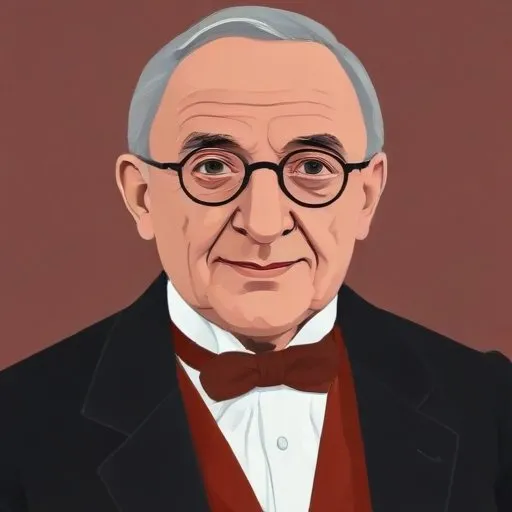
A Hungarian-German chemist and academic who discovered and named the elements hafnium and protactinium, and was awarded the Nobel Prize in Chemistry in 1943 for his work on radioactive isotopes.
George de Hevesy, a Hungarian radiochemist, left an indelible mark on the world of chemistry by pioneering the development of radioactive tracers to study chemical processes. In 1943, he was recognized with the Nobel Prize in Chemistry for his groundbreaking work, which revolutionized the field of radiochemistry and paved the way for numerous breakthroughs in medicine, biology, and physics.
Born on August 1, 1885, in Budapest, Hungary, George de Hevesy was the fifth of eight children to a wealthy and ennobled family of Hungarian-Jewish descent. His parents, Lajos Bischitz and Baroness Eugenia Jenny Schossberger, converted to Roman Catholicism, and his grandparents from both sides of the family had served as presidents of the Jewish community of Pest.
De Hevesy's academic journey began at the University of Budapest, where he studied chemistry for a year. He then moved to the Technical University of Berlin for several months before transferring to the University of Freiburg, where he met Ludwig Gattermann. In 1906, he started his Ph.D. thesis under the guidance of Georg Franz Julius Meyer and acquired his doctorate in physics in 1908.
De Hevesy's curiosity and passion for research led him to work with some of the most prominent scientists of his time. He collaborated with Fritz Haber in Karlsruhe, Germany, and then with Ernest Rutherford in Manchester, England, where he also met Niels Bohr. In 1918, he was appointed professor of physical chemistry in Budapest, and in 1920, he settled in Copenhagen.
In 1922, de Hevesy, along with Dirk Coster, made a groundbreaking discovery – the element hafnium (72Hf). This discovery was a testament to his collaborative spirit and his ability to bring together diverse expertise to achieve a common goal.
De Hevesy's work not only earned him the Nobel Prize in Chemistry but also paved the way for numerous scientific breakthroughs. His development of radioactive tracers enabled scientists to study chemical processes in living organisms, leading to significant advances in medicine, biology, and physics. His legacy continues to inspire generations of scientists, researchers, and scholars.
De Hevesy's work was guided by his strong belief in the power of collaboration and interdisciplinary research. He believed that the boundaries between chemistry, physics, and biology were artificial and that these disciplines should be studied in conjunction to achieve a deeper understanding of the natural world.
De Hevesy's discovery of radioactive tracers and his work on hafnium have had a profound impact on modern society. His research has enabled the development of new medical treatments, imaging technologies, and industrial applications. His legacy continues to shape the course of scientific inquiry and inspire new generations of researchers.
Born in 1879
A brilliant physicist who developed the theory of relativity and is considered one of the most influential scientists of the 20th century, known for his groundbreaking work in physics and mathematics.
Born in 1885
A pioneer in quantum mechanics, he introduced the concept of wave-particle duality, revolutionizing our understanding of atomic structure. His philosophical approach to science also explored the nature of reality and human understanding.
Born in 1867
A pioneering scientist who pioneered radioactivity research, discovering elements polonium and radium, and paving the way for breakthroughs in medicine and energy.
Born in 1901
A pioneer in nuclear physics, known for leading the team that developed the first nuclear reactor and playing a crucial role in the development of the atomic bomb.
Born in 1879
A pioneering nuclear chemist who discovered nuclear fission, a process that releases massive energy from atomic nuclei, and was awarded the Nobel Prize in Chemistry in 1944.
Born in 1878
Pioneering physicist who made groundbreaking contributions to nuclear physics, including the discovery of nuclear fission, and was the first woman to become a full professor of physics in Germany.
Born in 1868
Developed a process to synthesize ammonia, revolutionizing agriculture and warfare, and was awarded the Nobel Prize in Chemistry in 1918.
