


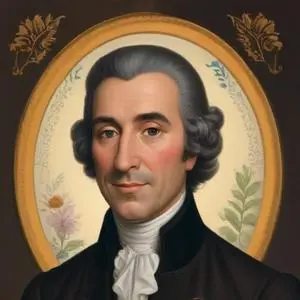
A French Enlightenment thinker who made significant contributions to mathematics, astronomy, and natural history, and is best known for his 44-volume encyclopedia, "Histoire Naturelle".
Georges-Louis Leclerc, Comte de Buffon, was a French naturalist, mathematician, and cosmologist who revolutionized the field of natural history with his groundbreaking works. He is best known for his monumental 36-volume encyclopedia, Histoire Naturelle, which laid the foundation for modern natural history and influenced two generations of scientists, including Jean-Baptiste Lamarck and Georges Cuvier.
Born on September 7, 1707, in Montbard, Burgundy, Buffon was the son of Benjamin François Leclerc, a minor local official, and Anne-Christine Marlin. He was named after his mother's uncle, Georges Blaisot, a wealthy tax farmer who later bequeathed a considerable fortune to his seven-year-old godson.
Buffon's early education took place at the Jesuit College of Godrans in Dijon, where he developed a strong foundation in mathematics and science. He later studied law in Dijon from 1723 to 1726, before pursuing his passion for mathematics and medicine.
In 1739, Buffon was appointed intendant of the Jardin du Roi, a prestigious botanical garden in Paris. This position allowed him to pursue his research and collection of natural history specimens, laying the groundwork for his monumental work, Histoire Naturelle.
During his tenure, Buffon oversaw the expansion of the Jardin du Roi, which became a hub for scientific discovery and learning. He also established a network of correspondents who contributed to his research, including scientists, travelers, and naturalists from around the world.
Buffon's magnum opus, Histoire Naturelle, was published in 36 volumes between 1749 and 1788. This comprehensive work covered a wide range of topics, including zoology, botany, geology, and anthropology, and featured over 2,000 illustrations.
Histoire Naturelle was a groundbreaking work that revolutionized the field of natural history. It introduced new concepts, such as the idea of species change over time, and provided a systematic classification of living organisms. The work also featured detailed descriptions of natural phenomena, such as the formation of fossils and the behavior of animals.
Buffon's work had a profound impact on the development of natural history, influencing scientists such as Jean-Baptiste Lamarck and Georges Cuvier. Ernst Mayr, a prominent evolutionary biologist, hailed Buffon as "the father of all thought in natural history in the second half of the 18th century."
Buffon's work was not without controversy, as his theories about geological history and animal evolution contradicted the biblical narrative of creation. In 1751, he was forced to recant his views by the theology committee at the University of Paris, a decision that he later regretted.
Despite these setbacks, Buffon continued to advance his ideas, which laid the foundation for modern evolutionary theory. His work also influenced the development of cosmology, as he proposed a new model of the universe that challenged traditional Aristotelian views.
Buffon's legacy extends far beyond his scientific contributions. He played a critical role in popularizing science and making it accessible to a broad audience. His work also inspired a new generation of scientists, naturalists, and thinkers.
Today, Buffon is remembered as one of the greatest scientists of the 18th century, and his work continues to influence fields such as biology, ecology, and anthropology. His emphasis on observation, experimentation, and empirical evidence set a new standard for scientific inquiry, shaping the course of modern science.
In conclusion, Georges-Louis Leclerc, Comte de Buffon, was a pioneering scientist who revolutionized the field of natural history with his groundbreaking works. His legacy continues to inspire and influence scientists, thinkers, and scholars around the world.
Born in 1707
Developed the system of binomial nomenclature, which is still used today to classify and name living organisms. This system has had a profound impact on the fields of biology, ecology, and conservation.
Born in 1744
A French soldier, biologist, and academic who developed a theory of inheritance of acquired characteristics, proposing that organisms adapt to their environment and pass on those traits to their offspring.
Born in 1749
Developed nebular hypothesis of the origin of the solar system and formulated Laplace's equation, a fundamental concept in mathematics and physics. He's considered the founder of celestial mechanics.
Born in 1743
Father of modern chemistry, discovered oxygen, and developed a systematic method of chemical nomenclature. He laid the foundation for modern chemistry and paved the way for future scientific discoveries.
Born in 1867
A pioneering scientist who pioneered radioactivity research, discovering elements polonium and radium, and paving the way for breakthroughs in medicine and energy.
Born in 1809
Developed the theory of evolution through natural selection, revolutionizing our understanding of life on Earth. This groundbreaking idea transformed the fields of biology, ecology, and beyond.
Born in 1712
A pioneering thinker who shaped modern democracy and education with his ideas on social contracts, general will, and the importance of early childhood education. His writings influenced the French Revolution and modern political thought.
Born in 1694
A witty and insightful 18th-century writer and philosopher who used satire to critique societal norms and advocate for reason, tolerance, and human rights.
