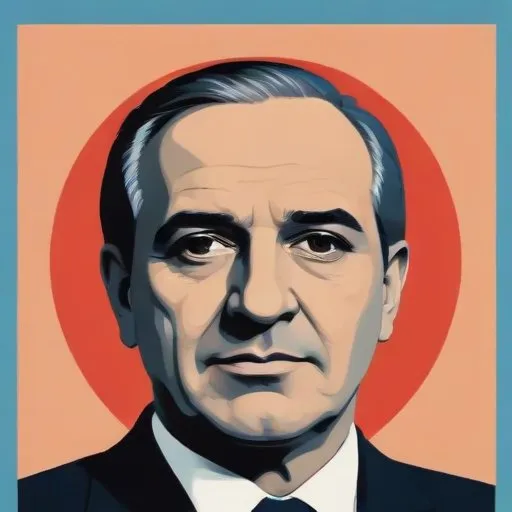
Georgios Papadopoulos: The Military Officer and Dictator Who Shaped Greece's History
A Military Coup and Rise to Power
Georgios Papadopoulos, a Greek military officer, is known for leading a coup d'état in Greece in 1967 and becoming the country's Prime Minister from 1967 to 1973. During his rule, he also served as the President of Greece under the junta in 1973, following a referendum.
Early Life and Military Career
Born on May 5, 1919, in Elaiohori, a small village in the Prefecture of Achaea in the Peloponnese, Papadopoulos came from a family of local schoolteachers. He was the eldest son and had two brothers, Kosmas and Xenophon. Papadopoulos joined the Hellenic Army during World War II and resisted the Greco-Italian War, earning honors and recognition as a hero. After the war, he remained in the army and rose to the rank of colonel.
The Military Junta and Authoritarian Rule
On April 21, 1967, Papadopoulos, along with a group of mid-level army officers, overthrew the democratic government and established a military junta that lasted until 1974. Assuming dictatorial powers, he led an authoritarian, anticommunist, and ultranationalist regime. During his rule, he abolished the Greek monarchy and established a republic, with himself as president.
Downfall and Trial
In 1973, Papadopoulos was overthrown and arrested by his co-conspirator, Brigadier General
Dimitrios Ioannidis. After the Metapolitefsi, which restored democracy in 1974, Papadopoulos was tried for his part in the crimes of the junta and sentenced to death. However, his sentence was commuted to life imprisonment. Refusing several offers of clemency in exchange for admitting guilt for the crimes of the junta, Papadopoulos spent the remainder of his life in prison.
Legacy and Impact on Greek Society
Papadopoulos's legacy and the impact of his regime on Greek economy and society remain fiercely debated. His rule was marked by suppression of dissent, censorship, and human rights violations. However, his authoritarian government also implemented some economic and social reforms, such as the establishment of a national health system and the expansion of education.
Personal Milestones and Key Life Events
- 1919: Born on May 5th in Elaiohori, Achaea
- 1940s: Joined the Hellenic Army during World War II
- 1967: Led a military coup and became Prime Minister of Greece
- 1973: Overthrown and arrested by Dimitrios Ioannidis
- 1974: Tried and sentenced to life imprisonment
- 1999: Died on June 27th in prison
Trivia and Fun Facts
- Papadopoulos was known for his charismatic leadership and oratory skills.
- He was a strong admirer of Napoleon Bonaparte and often compared himself to the French leader.
- During his rule, Papadopoulos implemented a policy of "Greek grandeur," aiming to restore Greece's perceived past glory.
Comparative Analysis with Contemporaries
Papadopoulos's regime and policies can be compared to those of other authoritarian leaders of the time, such as Spain's
Francisco Franco and Portugal's
António de Oliveira Salazar. Like them, Papadopoulos used nationalist and anticommunist rhetoric to justify his rule and suppress dissent.
Influence on Modern Society
Papadopoulos's legacy continues to shape Greek politics and society today. His regime's impact on the country's economy, education system, and human rights record remains a topic of debate and discussion. Despite his controversial rule, Papadopoulos remains a significant figure in modern Greek history.
FAQ
What was Georgios Papadopouloss role in Greek politics?
Georgios Papadopoulos was a Greek colonel and politician who served as the 169th Prime Minister of Greece from 1967 to 1973. He was the leader of the Greek military junta that ruled Greece from 1967 to 1974.
How did Georgios Papadopoulos come to power?
Papadopoulos led a military coup in 1967, overthrowing the government and establishing a military junta. He served as Prime Minister and later as Regent, consolidating power and suppressing political opposition.
What were some of Georgios Papadopouloss notable policies?
During his rule, Papadopoulos introduced several policies aimed at modernizing Greeces economy and infrastructure, including the development of tourism, telecommunications, and transportation networks.
How did Georgios Papadopouloss regime end?
The Papadopoulos regime was ousted in 1974, following a failed coup attempt in Cyprus and growing domestic opposition. He was arrested, tried, and imprisoned for his role in the military junta.
What is Georgios Papadopouloss legacy in Greek politics?
Papadopoulos is remembered as a controversial figure who played a significant role in modern Greek history. His regime was marked by authoritarianism and human rights abuses, but he also implemented several significant economic and infrastructure development projects.