


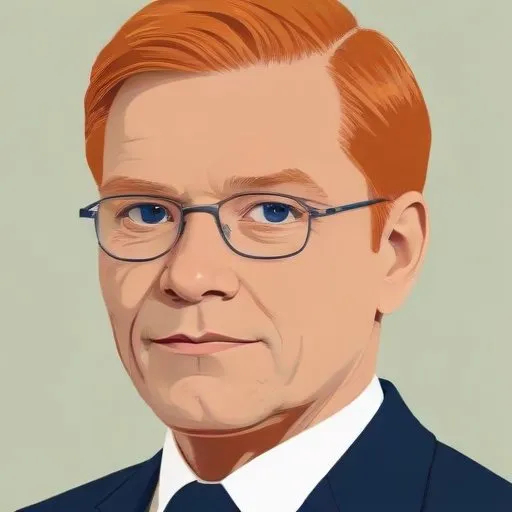
A Dutch civil servant and politician who played a key role in shaping the country's post-war reconstruction and served as the Queen's Commissioner in the province of Gelderland. He's also known for his efforts in promoting regional development and European integration.
Gerrit Ybema, a renowned Dutch politician, is best known for his prominent roles in the Democrats 66 (D66) party and his significant contributions to the country's economic landscape. As a Member of the House of Representatives and State Secretary for Economic Affairs, Ybema played a crucial part in shaping the Netherlands' economic policies during the late 20th and early 21st centuries.
Born on October 29, 1945, in Schettens, Friesland, Ybema nurtured a deep interest in economics from an early age. He pursued this passion at the University of Groningen, where he graduated cum laude in 1977 with a degree in economics.
Ybema's political career began in 1986, when he became an advisor to the Gedeputeerde Staten of Friesland province. This marked the starting point of his ascent in the D66 party. In 1989, he was elected to the municipal council of Leeuwarden, followed by his election to the House of Representatives in the same year. Throughout the 1990s, Ybema played a vital role in shaping the country's economic policies, serving as State Secretary for Economic Affairs in the Second Kok cabinet from 1998 to 2002.
During his tenure as State Secretary, Ybema was instrumental in implementing several key economic reforms. He played a crucial role in shaping the Netherlands' economic policy, particularly in the areas of trade and industry. His expertise in economics and politics earned him recognition and respect among his peers.
In recognition of his outstanding contributions to the field of economics and politics, Ybema was awarded the Order of Oranje-Nassau, Knight, on December 10, 2002.
Ybema's personal life was marked by his commitment to his family and community. He was married and lived in the Frisian village of Uitwellingerga. He had three children with his first wife and was a stepfather to two children from his second wife's previous marriage. Throughout his life, Ybema remained dedicated to his work, leaving behind a legacy that continues to inspire future generations of politicians and economists.
In the latter years of his life, Ybema founded Ybema Economy Solutions, a consultancy company that leveraged his vast expertise in economics and politics to provide valuable insights to clients.
Gerrit Ybema's remarkable journey serves as a testament to his unwavering commitment to the world of economics and politics. His contributions to the Netherlands' economic landscape continue to have a lasting impact, inspiring future leaders to follow in his footsteps.
95 Years Old
A Dutch journalist and politician who served as Deputy Prime Minister of the Netherlands, known for his progressive views and leadership in the Democrats 66 party. He played a key role in shaping the country's social and economic policies.
88 Years Old
Led the Netherlands as Prime Minister from 1994 to 2002, implementing significant economic reforms and guiding the country's integration into the European Union. He's also known for his role in shaping the country's social and economic policies.
Born in 1919
A Dutch journalist, economist, and politician who served as Deputy Prime Minister of the Netherlands, known for his progressive policies and efforts to reduce economic inequality. He played a key role in shaping the country's social and economic landscape.
95 Years Old
A Dutch statesman who served as Prime Minister of the Netherlands from 1977 to 1982, known for his progressive policies and European integration efforts.
87 Years Old
The Prime Minister of the Netherlands from 1982 to 1994, known for leading the country through a period of economic growth and implementing significant welfare state reforms. He also served as the United Nations High Commissioner for Refugees from 2001 to 2005.
Born in 1903
A Dutch economist and academic who developed the first national economic model and was awarded the first Nobel Prize in Economics in 1969 for his work on econometrics.
