


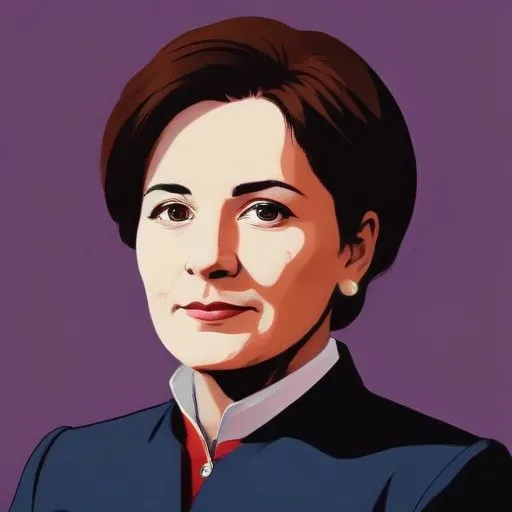
Austrian Social Democratic Party member who served as a Minister of Social Affairs and advocated for women's rights and social welfare reforms.
Gertrude Frhlich-Sandner, a stalwart of Austrian politics, was a pioneering figure who reshaped the country's political landscape. As a prominent member of the Social Democratic Party of Austria (SPÖ), she left an indelible mark on the nation's governance, championing the causes of social justice, equality, and women's empowerment.
Born on April 25, 1926, in Vienna, Austria, Gertrude Kastner, as she was known then, grew up during a tumultuous period in European history. As World War II ravaged the continent, she developed a deep understanding of the importance of social responsibility and collective action. This empathy-driven worldview would eventually propel her into the realm of politics.
Frhlich-Sandner's entry into politics was marked by her involvement with the SPÖ, where she quickly rose through the ranks. Her dedication to social welfare, education, and women's rights resonated with the party's ideals, earning her widespread recognition and respect. Her tireless efforts culminated in her appointment as an honorary citizen of Vienna in 1993, a testament to her immense contributions to the city and its people.
Frhlich-Sandner's political philosophy was deeply rooted in the principles of social democracy. She fervently believed in the power of collective action, advocating for a more equitable distribution of resources and opportunities. Her commitment to women's empowerment was unwavering, as she strove to bridge the gender gap and create a more inclusive society.
Frhlich-Sandner's life was marked by significant milestones, both personal and professional. Her marriage to Friedrich Sandner and her experiences as a mother deeply influenced her political stance on family and social issues. Her own struggles as a woman in a male-dominated political arena instilled in her a sense of determination, driving her to fight for others' rights.
Gertrude Frhlich-Sandner's legacy continues to inspire generations of Austrian citizens, particularly women. Her unwavering commitment to social justice and equality has left a lasting impact on the country's political landscape, paving the way for future generations of leaders and change-makers.
"The struggle for women's rights is not a fight against men, but a fight for a better future for all."
Frhlich-Sandner's life and career were inextricably linked to Austria's turbulent post-war era. Her contributions to the country's reconstruction and development have secured her place in Austrian history. As a trailblazer in Austrian politics, she has inspired countless women to take up the mantle of leadership, leaving behind a rich legacy that continues to shape the nation's politics and society.
Gertrude Frhlich-Sandner's remarkable life serves as a testament to the power of dedication, perseverance, and conviction. Her unrelenting pursuit of social justice and equality has left an indelible mark on Austria, inspiring future generations to strive for a better world.
Born in 1911
The 22nd Chancellor of Austria, a prominent figure in post-WWII Austrian politics, known for his social democratic policies and efforts to maintain Austria's neutrality during the Cold War.
Born in 1918
An Austrian colonel and politician who served as the 9th President of Austria, known for his controversial past as a Nazi officer during World War II. He was also the Secretary-General of the United Nations from 1972 to 1981.
Born in 1891
An Austrian engineer and politician who served as Chancellor of Austria from 1953 to 1961, known for leading the country to independence and economic growth after World War II. He played a key role in shaping Austria's post-war identity and rebuilding its economy.
Born in 1890
The 6th President of Austria, a decorated war hero, and a unifying figure who played a crucial role in rebuilding the country after World War II. He's most known for his efforts to maintain Austrian neutrality during the Cold War.
Born in 1791
A German war hero and writer, known for his patriotic poetry and novels that inspired the German resistance during World War II.
Born in 1915
The 8th President of Austria, a judge and politician who played a key role in shaping the country's post-war identity and served as a unifying figure during a tumultuous period. He's most known for his commitment to democracy and human rights.
