


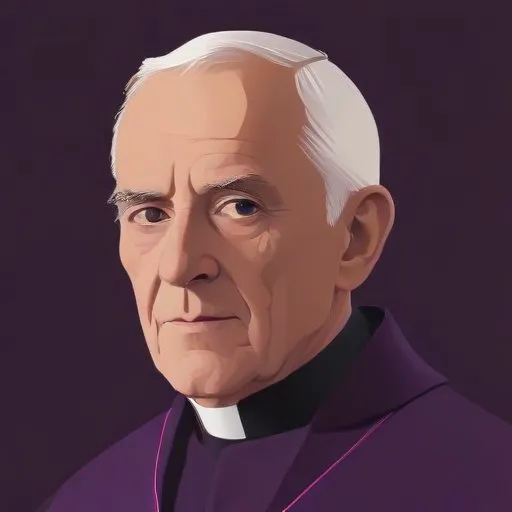
Leader of the Church of England during the Restoration period, known for his strong anti-Catholic stance and role in the formation of the Church of England's doctrine.
As the Archbishop of Canterbury from 1663 until his death in 1677, Gilbert Sheldon left an indelible mark on the Church of England, reinvigorating its traditions and consolidating its authority in the face of turmoil and reform. This influential religious leader is remembered for his pivotal role in shaping the Church's response to the tumultuous landscape of 17th-century England.
Born on June 19, 1598, in Stanton, Staffordshire, Gilbert Sheldon was the youngest son of Roger Sheldon, who worked for Gilbert Talbot, the 7th Earl of Shrewsbury. He received his education at Trinity College, Oxford, where he matriculated in 1614, graduating with a BA in 1617 and an MA in 1620. Later, he was incorporated at Cambridge and elected fellow of All Souls College, Oxford, where he earned his BD in 1628 and DD in 1634.
Sheldon's ecclesiastical career began in 1622, when he was ordained and appointed as domestic chaplain to Thomas Coventry, the 1st Baron Coventry. He soon became acquainted with William Laud, who would later become a significant figure in his life. In 1636, Sheldon was elected warden of All Souls College, where he played a crucial role in resisting Laud's appointment of Jeremy Taylor to a fellowship. Despite this, he went on to hold various positions, including provicechancellor of Oxford University in 1634 and 1640.
During the tumultuous years of the English Civil War, Sheldon gravitated towards the Royalist cause, forging close relationships with leaders like Lucius Cary, Viscount Falkland, and Edward Hyde. He participated in negotiations for the Uxbridge treaty, displaying his commitment to the royalist movement. As a royal chaplain, Sheldon's loyalty to the monarchy earned him the king's favor, paving the way for his future preferments.
In 1663, Sheldon was consecrated as the Archbishop of Canterbury, a position he held until his death in 1677. During his tenure, he worked tirelessly to restore the Church of England's authority, which had been eroded by the Puritan revolution. Sheldon's efforts culminated in the Act of Uniformity (1662), which enforced the use of the Book of Common Prayer in all Anglican churches.
Gilbert Sheldon's remarkable life, marked by his unwavering dedication to the Church of England and his royalist sympathies, has left an indelible mark on the history of the Anglican Communion.
Born in 1573
A 17th-century Archbishop of Canterbury who played a significant role in shaping the Church of England, known for his efforts to impose uniformity and suppress Puritanism.
Born in 1630
The last monarch of the House of Stuart, restored to the throne after a republican Commonwealth, known for his lavish spending, mistresses, and the Great Fire of London. He ruled with a mix of absolutism and indulgence, shaping England's Restoration era.
Born in 1594
A 17th-century bishop and academic who played a significant role in shaping the Church of England's liturgy and rituals, and is remembered for his efforts to restore traditional Catholic practices.
Born in 1887
Pioneering director, producer, and screenwriter behind iconic Broadway shows and films, including "Damn Yankees" and "The Pajama Game", known for blending music, comedy, and drama.
Born in 1924
Prolific author of macabre and suspenseful novels, often blending elements of horror, mystery, and dark humor, with works adapted into successful films and TV shows.
Born in 1522
A 16th-century bishop who played a key role in the English Reformation, helping to establish the Church of England and writing influential theological works.
