


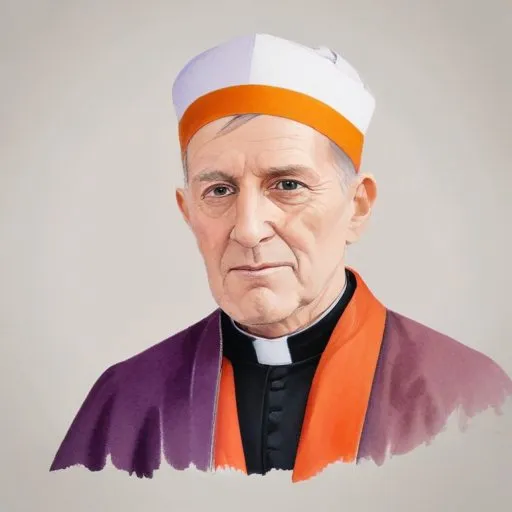
A 16th-century bishop who played a key role in the English Reformation, helping to establish the Church of England and writing influential theological works.
John Jewel, born on May 24, 1522, in Devon, England, is renowned for his influential role as Bishop of Salisbury from 1559 to 1571, and his instrumental contribution to the Elizabethan Settlement, a pivotal moment in English religious history.
John Jewel was the youngest son of John Jewel of Bowden and Alice Bellamye, daughter of Richard Bellamye. Under the guidance of his uncle John Bellamy, rector of Hampton, and other private tutors, Jewel received a solid education before matriculating at Merton College, Oxford, in July 1535. At Oxford, he was taught by John Parkhurst, later Bishop of Norwich, and excelled academically, earning his BA in 1540 and MA in 1545.
Jewel's intellectual prowess and leadership skills propelled him to prominence at Oxford, where he became a respected teacher and a key disciple of Pietro Martire Vermigli, also known as Peter Martyr. In 1547, he was elected fellow of Corpus Christi College, Oxford, and later graduated BD in 1552. His academic achievements and reputation earned him the position of vicar of Sunningwell, near Oxford, and public orator of the university.
During the tumultuous reign of Queen Mary I, Jewel's Protestant sympathies led to his exile. In April 1554, he acted as notary to Thomas Cranmer and Nicholas Ridley at their disputation, but soon after, he signed Catholic articles and fled to London, and subsequently to Frankfurt. There, he sided with Richard Coxe against John Knox, only to join Peter Martyr at Strasbourg and later visit Padua.
Upon Queen Elizabeth I's succession, Jewel returned to England and played a crucial role in shaping the Elizabethan Settlement. He worked tirelessly to establish a middle ground between Catholics and Puritans, formulating a distinct stance that would come to define the Church of England. Jewel's efforts ultimately led to the creation of the Thirty-Nine Articles, a foundational document that has shaped Anglican theology to this day.
John Jewel's contributions to the Elizabethan Settlement have had a profound and lasting impact on English religious history. His commitment to finding a balance between Catholic and Puritan factions helped establish the Church of England as a distinct entity. Through his writings, teachings, and leadership, Jewel left an indelible mark on the country's spiritual landscape.
Jewel's legacy extends beyond the Church of England, influencing Christian theology, ecumenism, and interfaith dialogue. His commitment to religious tolerance and his role in shaping the Elizabethan Settlement have had far-reaching consequences, shaping the course of English history and beyond.
Through his remarkable life, John Jewel has left an enduring legacy, shaping the course of English history and the Church of England. His commitment to religious tolerance, his intellectual prowess, and his leadership have inspired generations, cementing his place as one of the most influential figures of the 16th century.
Born in 1489
Leader of the English Reformation, instrumental in creating the Church of England and authoring the Book of Common Prayer.
Born in 1284
The king whose disastrous reign led to his eventual deposition and mysterious death, remembered for his alleged homosexual relationships and power struggles with nobles.
Born in 1504
The Archbishop of Canterbury from 1559 to 1575, known for his role in shaping the Church of England and promoting a moderate Protestantism. He was a key figure in the English Reformation.
Born in 1924
Prolific author of macabre and suspenseful novels, often blending elements of horror, mystery, and dark humor, with works adapted into successful films and TV shows.
Born in 1546
A 16th-century English Jesuit priest who plotted against Queen Elizabeth I and wrote influential Catholic tracts, earning him notoriety as a counter-Reformation figure.
Born in 1573
A 17th-century Archbishop of Canterbury who played a significant role in shaping the Church of England, known for his efforts to impose uniformity and suppress Puritanism.
