


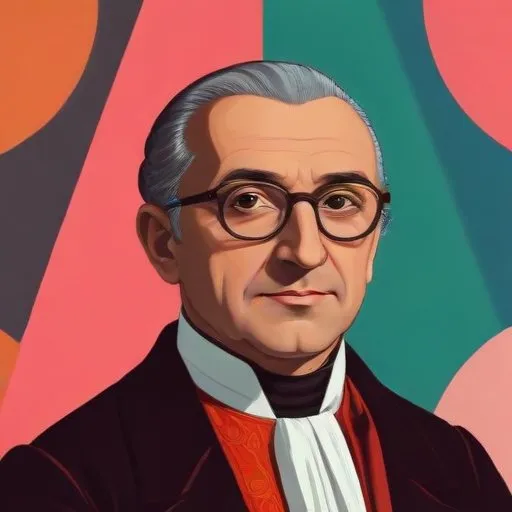
An 18th-century Italian physicist who made significant contributions to the study of electricity, particularly in the discovery of the electrification of metals. He's also known for his work on atmospheric electricity and the development of lightning rods.
Giovanni Battista Beccaria was a renowned Italian physicist who left an indelible mark on the world of electricity, and his groundbreaking contributions continue to inspire scientists to this day. He is credited with spreading knowledge of Benjamin Franklin's electrical researches, classifying luminous discharges, collecting data on atmospheric electricity, and designing the electrical thermometer.
Beccaria was born on October 3, 1716, in Mondovì, Italy. At the tender age of 16, he entered the religious Order of the Pious Schools or Piarists, where he studied and later taught grammar and rhetoric. During this period, he also developed a passion for mathematics, which would eventually become the foundation of his pioneering work in physics.
Beccaria's academic prowess earned him the position of professor of experimental physics at the University of Palermo and later at the University of Rome. His ability as an instructor was soon recognized, and he was appointed by royal authority as professor of physics. It was during this time that he published several papers on electrical subjects in the Phil. Trans., solidifying his reputation as a leading authority in the field.
One of his most significant contributions was the publication of his treatise on electricity, Elettricismo artificiale e naturale libri due, in 1753. This work was translated into English thanks to Benjamin Franklin's interest, further cementing Beccaria's status as a pioneer in the field of electricity.
Beccaria's work had a profound impact on the development of electricity, influencing some of the most prominent scientists of his time, including Alessandro Volta and Luigi Galvani. His research inspired a new generation of physicists, including Joseph-Louis Lagrange, Giovanni Francesco Cigna, and Giuseppe Angelo Saluzzo, who would go on to make significant contributions to the field.
Benjamin Franklin himself praised Beccaria's work, noting in a letter to Cadwallader Colden that he "seems a Master of Method, and has reducd to systematic Order the scatterd Experiments and Positions deliverd in my Papers."
Joseph Priestley, in his History and Present State of Electricity, declared Beccaria the "great Italian genius who had far surpassed everything done by French and English electricians."
Beccaria's legacy extends beyond his scientific contributions. He was a fellow of the Royal Society and was recognized for his ability to make complex scientific concepts accessible to a broader audience.
Beccaria's dedication to his work was unwavering, and he continued to teach and conduct research until his death on May 27, 1781. His life's work was a testament to his passion for science and his desire to illuminate the world of electricity.
Giovanni Battista Beccaria's groundbreaking contributions to the world of electricity continue to inspire scientists and scholars to this day. His legacy serves as a testament to the power of human ingenuity and the importance of making complex scientific concepts accessible to a broader audience.
Born in 1745
Italian physicist who invented the first electrical battery, revolutionizing the field of electricity and paving the way for countless technological advancements.
Born in 1737
Pioneering researcher who discovered bioelectricity, sparking a new understanding of the human body and paving the way for modern medical advancements.
Born in 1731
A pioneering scientist who discovered hydrogen and determined the density of the Earth, making significant contributions to the fields of chemistry and physics.
Born in 1749
Developed nebular hypothesis of the origin of the solar system and formulated Laplace's equation, a fundamental concept in mathematics and physics. He's considered the founder of celestial mechanics.
Born in 1707
Developed the system of binomial nomenclature, which is still used today to classify and name living organisms. This system has had a profound impact on the fields of biology, ecology, and conservation.
Born in 1608
Developed the mercury barometer, a device that measures atmospheric pressure, and made significant contributions to the study of vacuums and fluids.
