


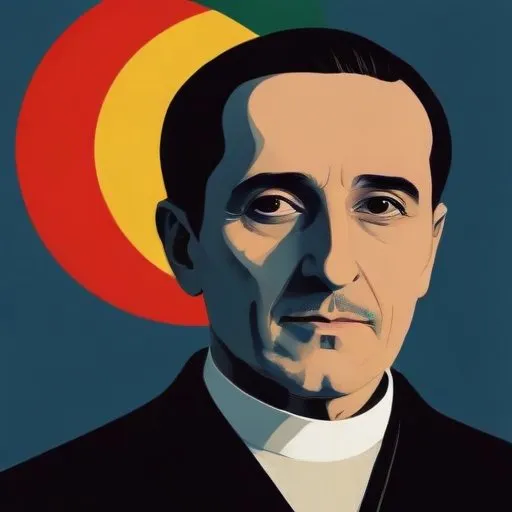
An Italian priest and mathematician who developed a significant contribution to non-Euclidean geometry, particularly in the study of hyperbolic geometry.
Giovanni Girolamo Saccheri, a renowned Italian Jesuit priest, philosopher, and mathematician, is primarily known for his groundbreaking work in non-Euclidean geometry. His magnum opus, Euclides ab omni naevo vindicatus (Euclid Freed of Every Flaw), published in 1733, is considered a pioneering exploration of this fascinating branch of mathematics.
Saccheri was born on September 5, 1667, in Sanremo, Genoa (now Italy), to a lawyer father. From a young age, he demonstrated exceptional precocity and a curious nature. In 1685, he entered the Jesuit novitiate, where he began his philosophical and theological studies.
Saccheri's mathematics teacher at the Jesuit College of Brera in Milan was the illustrious Tommaso Ceva. Ceva introduced Saccheri to his brother Giovanni and encouraged him to pursue mathematical research. Saccheri's first published work, Quaesita geometrica (1693), showcased his remarkable skills in solving six geometric problems proposed by the Sicilian mathematician Ruggero Ventimiglia.
Saccheri taught philosophy at the University of Turin from 1694 to 1697 and later at the University of Pavia from 1697 until his death. His notable publications include:
Saccheri's Logica demonstrativa demonstrated his innovative approach to definitions, distinguishing between real and nominal definitions. This concept, later recognized by Thomas Heath, solidified Saccheri's place in the history of modern logic.
Saccheri's work in non-Euclidean geometry, although largely overlooked during his lifetime, was rediscovered in the 19th century by Eugenio Beltrami. Today, Saccheri is regarded as a forerunner in this field, paving the way for later mathematicians.
Saccheri was ordained as a priest in March 1694. He maintained close scientific relationships with Tommaso and Giovanni Ceva, his mentors and friends. Although he died on October 25, 1733, in Milan, his contributions to mathematics and philosophy continue to inspire and influence scholars to this day.
Saccheri's pioneering work in non-Euclidean geometry has far-reaching implications for various fields, including architecture, engineering, and physics. His mathematical discoveries have enabled the development of innovative solutions, shaping the modern world we live in.
Did you know that Saccheri's Euclides ab omni naevo vindicatus was published just months before his death? This testament to his dedication and passion for mathematics has become a legendary tale in the annals of mathematical history.
Born in 1564
Pioneering astronomer, physicist, and mathematician who played a major role in the Scientific Revolution, making key discoveries that challenged Aristotelian views and laid the foundation for modern science.
Born in 1596
Developed influential philosophical and mathematical concepts, including the famous phrase "I think, therefore I am," and laid the foundation for modern Western philosophy.
Born in 1623
A 17th-century genius who made major contributions to mathematics, physics, and philosophy, inventing the mechanical calculator and developing the theory of probability. His writings also explored the human condition and faith.
Born in 1573
A 17th-century astronomer and Jesuit who made significant contributions to the study of sunspots and invented the helioscope, an instrument used to observe the Sun safely.
Born in 1508
An Italian Renaissance astronomer and philosopher who wrote influential works on astronomy, philosophy, and literature, including a commentary on Aristotle's "De Caelo".
