


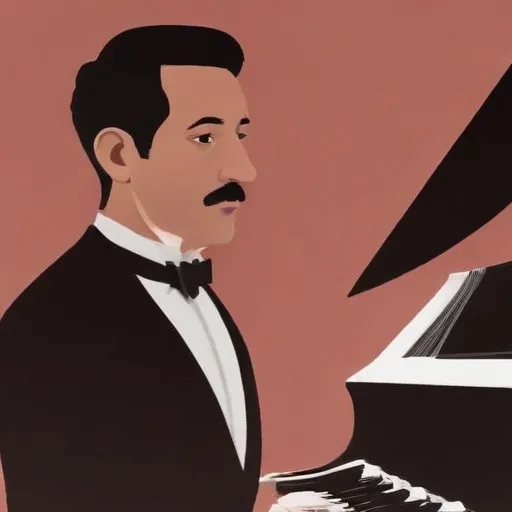
A renowned Italian musician of the late Romantic era, known for his symphonic works and operas that blended traditional Italian style with Germanic influences. He was also a prominent conductor and pianist of his time.
Giuseppe Martucci, often referred to as the "Italian Brahms," was a renowned Italian composer, conductor, pianist, and teacher who dedicated his entire career to absolute music, refraining from composing operas, a rare phenomenon among Italian composers of his era. His remarkable contribution to the world of classical music lies in his tireless efforts to revive Italian interest in non-operatic music.
Born on January 6, 1856, in Capua, Campania, Martucci was a child prodigy who began playing the piano in public at the tender age of eight. He received his initial lessons from his father, Gaetano, a trumpet player. At 11, he enrolled in the Naples Conservatory, where he was mentored by Professor Beniamino Cesi, a former student of Sigismond Thalberg.
Martucci's career as an international pianist took off in 1875, when he embarked on a tour of Germany, France, and England at the age of 19. He was appointed piano professor at the Naples Conservatory in 1880 and later moved to Bologna in 1886, replacing Luigi Mancinelli at the Bologna Conservatory. In 1902, he returned to Naples as the director of the Royal Conservatory of Music.
In 1881, Martucci made his conducting debut, marking the beginning of a new chapter in his career. A great admirer of Wagner, he introduced some of the composer's works to Italy, including the first Italian performance of Tristan und Isolde in 1888 in Bologna.
Martucci's impact on Italian music was profound, as he played a crucial role in reviving interest in non-operatic music. As a teacher, he mentored notable composers like Ottorino Respighi, who went on to become prominent figures in the world of classical music.
Martucci's son, Paolo, born in 1883, followed in his father's footsteps, becoming a pianist of repute and briefly teaching at the Cincinnati Conservatory. Giuseppe Martucci passed away on June 1, 1909, in Naples, leaving behind a rich legacy in the world of classical music.
Today, Martucci is remembered as a pioneering figure who played a vital role in shaping the course of Italian music. His dedication to absolute music and his tireless efforts to promote non-operatic works have left an indelible mark on the world of classical music.
Born in 1866
An Italian composer and academic, he is most known for his operas, particularly "Adriana Lecouvreur", which remains a staple of the operatic repertoire.
Born in 1857
Creator of the iconic opera "Pagliacci," known for its famous aria "Vesti la giubba," which has become a cultural touchstone. This opera's themes of love, betrayal, and tragedy continue to resonate with audiences today.
