


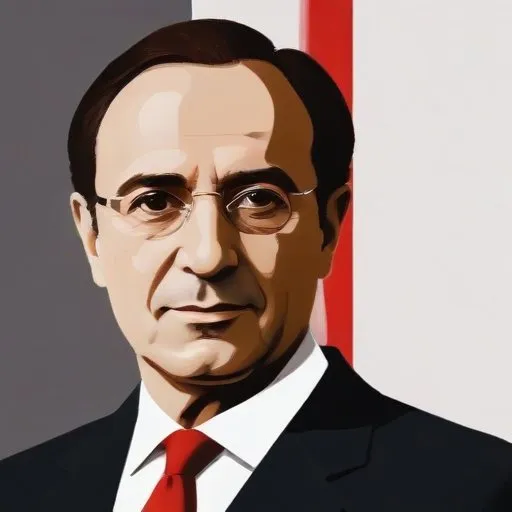
The 32nd Prime Minister of Italy, serving from 1953 to 1954, known for his brief but significant tenure during Italy's post-war reconstruction period. He played a crucial role in shaping the country's economic and political landscape.
Giuseppe Pella was a renowned Italian Christian Democratic politician and statesman who served as the 31st prime minister of Italy from 1953 to 1954, leaving an indelible mark on the country's post-war history. He played a pivotal role in shaping Italy's economic landscape, implementing laissez-faire economic and monetary policies that fueled the country's remarkable economic growth, known as the "Italian economic miracle."
Born on April 18, 1902, in Valdengo, Piedmont, Pella was the second son of Luigi Pella and Viglielmina Bona, sharecroppers on a small farm. He pursued his education with determination, obtaining his elementary school certificate privately and later attending technical schools in Biella and an accounting institute in Turin.
After graduating in Economy and Commerce at the Royal Superior Institute of Turin in 1924, Pella became a professor of accounting at the Sapienza University of Rome and University of Turin. He also worked as a tax advisor and auditor, eventually joining the National Fascist Party (PNF) to continue his occupation under the regime of Benito Mussolini.
In the late 1930s, Pella was appointed deputy podest of Biella, tasked with reorganizing the city's financial system. During the Italian Civil War, he cooperated with the National Liberation Committee (CLN), a political umbrella organization and the main representative of the Italian resistance movement fighting against the German occupation of Italy.
After the war, Pella's political career gained momentum. He served as Minister of Treasury, Budget, and Foreign Affairs during the 1950s and early 1960s, playing a crucial role in shaping Italy's post-war economy. In 1954, he became the President of the European Parliament, succeeding Alcide De Gasperi.
Pella's economic policies had a profound impact on Italy's post-war reconstruction. He implemented a series of reforms that promoted economic growth, industrialization, and modernization. His policies led to increased industrial production, improved infrastructure, and a significant reduction in unemployment.
Today, Giuseppe Pella is remembered as one of the most important politicians in Italy's post-war history. His legacy extends beyond his economic policies, as he played a vital role in promoting democracy, European integration, and international cooperation.
In 1934, Pella married Ines Maria Cardolle, with whom he had a daughter, Wanda, born in 1938. Despite his busy political career, Pella remained committed to his family and cherished his personal relationships.
Giuseppe Pella's remarkable career, spanning over three decades, left an indelible mark on Italy's political and economic landscape. His commitment to democracy, European integration, and economic growth continues to inspire future generations of politicians and policymakers.
"The future of Italy lies not in the hands of a single individual, but in the collective efforts of a united people."
"Economic growth is not an end in itself, but a means to promote social justice and human dignity."
These quotes, spoken by Pella during his tenure as prime minister, encapsulate his vision for a prosperous and equitable Italy, where economic growth is harnessed to promote social welfare and human dignity.
Born in 1881
Italian journalist and politician who served as the 30th Prime Minister of Italy, leading the country's post-WWII reconstruction and European integration efforts. He's known for his key role in shaping modern Italy's politics and economy.
Born in 1908
Italian journalist and politician who served as Prime Minister of Italy six times, playing a key role in shaping the country's post-war politics and economy. He was a dominant figure in Italian politics for over three decades.
Born in 1916
The 39th Prime Minister of Italy, a prominent figure in post-war Italian politics, known for his efforts to establish a historic compromise between Christian Democrats and Communists. He was kidnapped and murdered by the Red Brigades in 1978.
Born in 1925
A prominent Italian journalist and politician who served as Prime Minister of Italy, known for his leadership during a tumultuous period in the country's history. He played a key role in shaping Italy's post-war politics and economy.
97 Years Old
An Italian academic and politician who served as the 8th President of Italy, known for his role in shaping the country's politics and foreign policy during the Cold War era. He was a key figure in Italy's transition from a monarchy to a republic.
Born in 1918
The 9th President of Italy, a lawyer and politician who played a key role in shaping the country's post-war politics and served as a senator for life. He's remembered for his strong stance against organized crime and corruption.
Born in 1919
A dominant figure in Italian politics, serving as Prime Minister seven times, known for his cunning and controversial leadership style. He was a key player in shaping Italy's post-war politics.
89 Years Old
A billionaire media mogul who dominated Italian politics for decades, known for his flamboyant personality and numerous scandals.
