


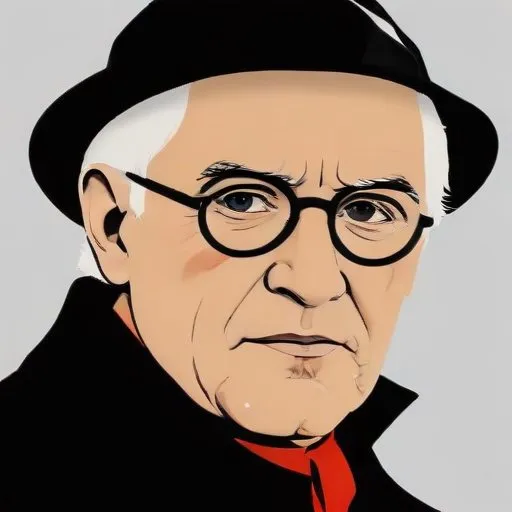
A renowned German historian and author, known for his in-depth analyses of European history, particularly the rise of fascism and National Socialism in Germany. His works are considered essential reading for understanding the complexities of modern European history.
Golo Mann was a renowned German historian and essayist, best known for his seminal work German History in the 19th and 20th Century, a comprehensive survey of German political history that shed light on the aberrant nature of the Hitler regime. This masterpiece, published in 1958, cemented Mann's reputation as a leading authority on German history and politics.
Mann was born Angelus Gottfried Thomas Mann on March 27, 1909, in Munich, Germany. He was the son of the celebrated writer Thomas Mann and his wife, Katia Pringsheim. Mann's maternal grandfather, Alfred Pringsheim, was a German Jewish mathematician and artist, while his paternal grandmother, Jlia da Silva Bruhns, was of Portuguese-Indigenous Brazilian descent.
Mann's early life was marked by his sensitive and nervous nature, which was often noted by his mother in her diary. Despite his father's occasional disappointment, Mann went on to pursue higher education, earning a doctorate in philosophy under the guidance of Karl Jaspers at Heidelberg University.
In 1933, Mann fled Hitler's Germany, following in the footsteps of his father and other family members. He spent time in France, Switzerland, and the United States before eventually reestablishing himself in Switzerland and West Germany as a literary historian in the late 1950s.
Mann's experiences during this period deeply influenced his perspective on German history and politics. He became a vocal critic of historians who sought to contextualize the crimes of the Hitler regime by comparing them to those of Stalinism in the Soviet Union and with wartime Allied bombing.
Mann's work was deeply influenced by his philosophical convictions. He believed that historians should adopt a nuanced and critical approach to understanding the past, rather than simply perpetuating nationalist or ideological narratives.
Throughout his career, Mann emphasized the importance of moral responsibility and individual accountability in shaping historical events. He advocated for a balanced approach to history, one that acknowledged both the achievements and the atrocities of the past.
Golo Mann's contributions to German historiography and literary criticism have been immense. His work continues to inspire scholars and intellectuals around the world, offering a rich and nuanced understanding of German history and politics.
Mann's legacy extends beyond the academic realm, as his work has influenced popular culture and public discourse. His commitment to critical thinking, moral responsibility, and intellectual honesty has left an enduring mark on German and European intellectual life.
Born in 1871
A prominent literary figure of the early 20th century, known for his socially critical and psychologically nuanced novels that explored the darker aspects of German society. His works often targeted the bourgeoisie and the rise of fascism.
Born in 1875
A renowned literary mastermind, celebrated for crafting complex, psychologically rich novels that probed the human condition, often blending philosophy and art.
Born in 1899
A celebrated German writer and poet, best known for his humorous and satirical children's books, such as "Emil and the Detectives" and "Lottie and Lisa", which have been beloved by generations of readers.
Born in 1898
A pioneering playwright and poet who revolutionized theater with his epic style, blending politics and art to create socially conscious works that continue to influence contemporary drama.
Born in 1877
A renowned poet, novelist, and painter, celebrated for his thought-provoking and introspective works that explore the human condition, spirituality, and the search for meaning. His writings often blended elements of psychology, philosophy, and mysticism.
Born in 1889
A German philosopher and academic who explored the meaning of existence, time, and human existence, influencing 20th-century philosophy with his concept of "Being-in-the-world".
Born in 1903
A critical theorist who critiqued modern society, culture, and capitalism, arguing that they perpetuate inequality and stifle individual freedom. His work influenced many fields, from sociology to musicology.
Born in 1906
A 20th-century philosopher and theorist who explored the nature of power, politics, and humanity, particularly in the context of totalitarianism and the Holocaust.
