


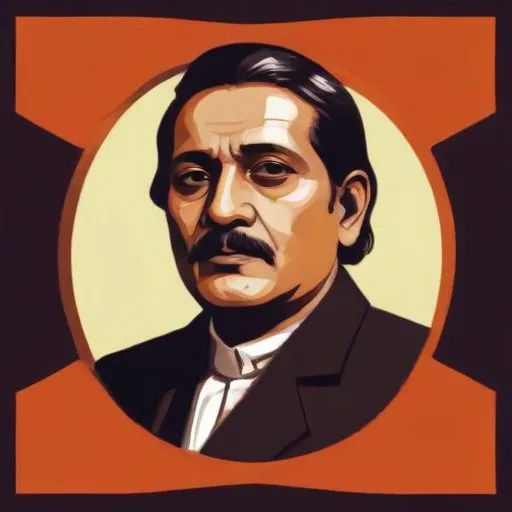
A pioneering journalist, poet, and activist who championed social reform and Indian independence through his writings and grassroots movements. He's revered for his contributions to Odia literature and his role in shaping India's freedom struggle.
Gopabandhu Das, fondly known as Utkalamani, was a multifaceted personality who left an indelible mark on Odisha's social, literary, and political landscape. As a social worker, reformer, political activist, journalist, poet, and essayist, Das was a beacon of hope for the people of Odisha, inspiring generations to strive for a better future.
Gopabandhu Das was born on October 9, 1877, in Suando village, near Puri, Odisha, to a Brahmin family. His father, Daitari Dash, was a Mukhtiar, and his mother, Swarnamayee Devi, was a kind-hearted woman who instilled in him the values of empathy and service to humanity. Das's early education began in his village, followed by middle school nearby, and later at Puri Zilla School, where he was influenced by his teacher, Mukhtiar Ramchandra Das, who instilled in him the spirit of nationalism and public service.
The inadequate response of authorities to a cholera outbreak in his village prompted Das to take action. He organized his fellow children to form a voluntary corps called Puri Sava Samiti, which helped victims of the outbreak and even cremated the dead. This selfless act marked the beginning of Das's journey as a social reformer, dedicated to improving the lives of his people.
Das's literary talents were evident from an early age. He began contributing to local literary magazines, such as Indradhanu and Bijuli, where he argued that any modern literary movement must acknowledge and build upon the past. His satirical poem, which enraged the Inspector of Schools, showcased his fearless spirit and commitment to speaking truth to power.
During his time at Ravenshaw College in Cuttack, Das, along with his friends, Brajasundar Das and Lokanath Patnaik, founded the Kartavya Bodhini Samiti (Duty Awakening Society). This discussion group focused on social, economic, and political problems, laying the groundwork for Das's future endeavors as a social reformer and political activist.
In 1903, Das attended the Utkal Sammilani (Utkal Union Conference), where he disagreed with the prevailing views, demonstrating his courage to challenge the status quo. This event marked a significant milestone in his life, as he began to assert himself as a powerful voice for change in Odisha.
Gopabandhu Das's legacy extends far beyond his remarkable achievements. He inspired countless individuals to dedicate themselves to social service, empowering them to strive for a better future. As a poet, essayist, and journalist, he continues to inspire generations with his works, which remain a testament to his unwavering commitment to the people of Odisha.
Today, Das is remembered as the Jewel of Odisha, a shining example of selflessness, courage, and dedication to the greater good. His life's work serves as a beacon of hope, inspiring us to emulate his example and strive for a better tomorrow.
Born in 1869
Indian freedom fighter, activist, and philosopher who led India to independence from British rule through non-violent civil disobedience, inspiring civil rights movements worldwide.
Born in 1861
A Bengali polymath who wrote extensively on love, nature, and humanity, creating a unique blend of Indian and Western literary styles, and was the first non-European to win the Nobel Prize in Literature.
Born in 1876
A renowned Bengali novelist celebrated for his poignant and thought-provoking works that explored the complexities of Indian society, particularly the lives of women and the rural poor.
Born in 1838
A pioneering Bengali writer and poet who played a significant role in shaping Indian literature, known for his iconic novel "Anandamath" that inspired India's freedom movement.
Born in 1820
A 19th-century polymath who championed social reforms, particularly women's education and widow remarriage, through his writings and art. He's also credited with introducing the concept of prose in Bengali literature.
