


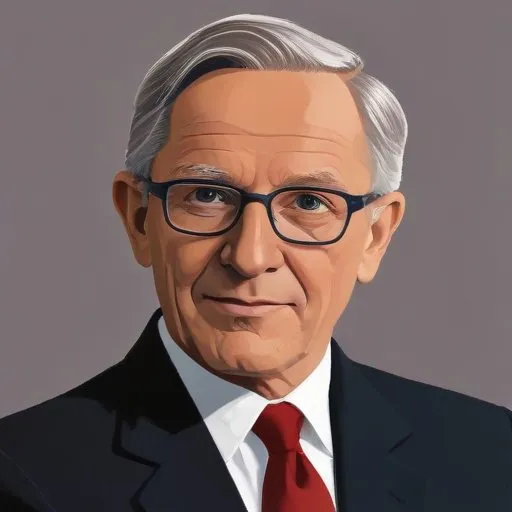
Developed the theory of public choice, which applies economic principles to political decision-making, and is known for his work on rent-seeking behavior.
Gordon Tullock, a pioneering American economist and professor of law and economics, is best known for his groundbreaking work on public choice theory, which applies economic thinking to political issues. His seminal contributions to the field have made him a founding figure in the realm of public choice, influencing generations of scholars and policymakers alike.
Born on February 13, 1922, in Rockford, Illinois, Tullock attended Rockford Central High School before pursuing higher education at the University of Chicago. After a brief interruption for military service during World War II, he earned his J.D. in 1947. He later attended Yale and Cornell universities for Chinese language instruction.
Tullock's early career took him to the Foreign Service, where he served from 1947 to 1956, with postings in Tianjin, China, Hong Kong, and Korea. However, his true calling lay in academia, where he began to collaborate with James M. Buchanan at the University of Virginia. This partnership led to the publication of The Calculus of Consent: Logical Foundations of Constitutional Democracy in 1962, a work that would become a cornerstone of public choice theory.
In 1966, Tullock and Buchanan co-founded the journal Public Choice, which provided a platform for scholars to apply economic theory to non-market phenomena, particularly in the realms of government and politics. Despite having no formal economics training, Tullock's work with Buchanan led to the establishment of an economics research program at the University of Virginia, which they ran for four years.
Tullock's work was characterized by a strong skepticism towards government intervention and a commitment to individual liberty. He believed that politicians and bureaucrats, like individuals, respond to incentives and make rational decisions based on their own self-interest. This perspective challenged conventional views of government as a benevolent entity, instead revealing the potential for self-interested behavior in the public sector.
Tullock's ideas have had a profound impact on modern society, influencing policy debates and shaping our understanding of government and politics. His work has inspired a generation of scholars, policymakers, and think-tank analysts to re-examine the role of government in society. By applying economic principles to political decision-making, Tullock's work has helped to promote more efficient and effective governance.
Tullock received numerous awards and honors for his contributions to economics and public choice theory. He was a fellow of the American Academy of Arts and Sciences and a member of the National Academy of Sciences. In 1998, he received the Association of Private Enterprise Education's Distinguished Scholar Award.
In addition to his academic achievements, Tullock's personal life was marked by a deep love of nature and the outdoors. An avid birdwatcher and conservationist, he was a long-time member of the Audubon Society and the Nature Conservancy.
Gordon Tullock's pioneering work has left an indelible mark on the field of public choice theory. His commitment to individual liberty, limited government, and economic analysis has inspired a new generation of scholars and policymakers. As a founding figure in his field, Tullock's legacy continues to shape our understanding of government and politics, informing policy debates and promoting more efficient governance.
Born in 1791
The 15th President of the United States, a northern Democrat who remained in office during the American Civil War, is infamous for his inaction in preventing the secession of 11 southern states. He's often regarded as one of the worst presidents in US history.
Born in 1910
A Nobel Prize-winning economist who challenged traditional views on business and government, famously arguing that firms exist to reduce transaction costs and that well-defined property rights can resolve environmental issues.
Born in 1912
A Nobel Prize-winning economist who championed free market capitalism and limited government intervention, known for his advocacy of laissez-faire economics and influential writings on monetary policy.
Born in 1911
A Nobel Prize-winning economist who made significant contributions to the field of economics, particularly in the areas of microeconomics and industrial organization, and is known for his work on the theory of regulation.
95 Years Old
A pioneer in applying economic theory to social issues, he's most known for his work on human capital, crime and punishment, and the economics of the family.
93 Years Old
A pioneering economist who challenged traditional theories by showing how communities can successfully manage shared resources, leading to a Nobel Prize in Economics in 2009.
99 Years Old
This Nobel Prize-winning economist is renowned for pioneering experimental economics, creating artificial markets to test economic theories and understand human decision-making. His work has far-reaching implications for policy-making and our understanding of human behavior.
Born in 1920
A pioneer in institutional economics, he's renowned for his groundbreaking work on the role of institutions in shaping economic growth and development.
