


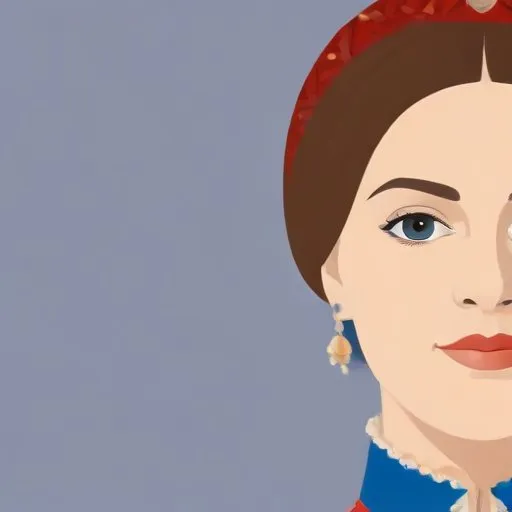
Daughter of Peter the Great, she played a crucial role in securing the throne for her son Peter III, influencing Russian politics and royal succession.
As the eldest daughter of Emperor Peter I of Russia and his wife Empress Catherine I, Grand Duchess Anna Petrovna of Russia was a woman of great intelligence, wit, and charm. Born on January 27, 1708, in Moscow, Russia, she would go on to become the Duchess Consort of Holstein-Gottorp by marriage, and although she never acceded to the throne, her legacy lived on through her son, Peter III, who would eventually become Emperor in 1762.
Born out of wedlock, although later legitimized, Anna and her younger sister Elizabeth were awarded the titles of princess tsarevna on March 6, 1711, and crown princess tsesarevna on December 23, 1721. Anna grew up in the houses of Peter's younger sister Natalia and Prince Alexander Menshikov, where she developed into an intelligent and well-read girl, speaking four foreign languages - French, German, Italian, and Swedish.
Although Anna was a potential heir to the throne, she never acceded to it due to political reasons. Her nephew, Peter II, ruled from 1727 to 1730, but Anna's own claim to the throne was overlooked. Instead, she married Charles Frederick, Duke of Holstein-Gottorp, in 1725, solidifying an alliance between Russia and Holstein-Gottorp.
Although Anna's life was cut short, her legacy lived on through her son, Peter III, who would go on to become Emperor of Russia. Her own intelligence, wit, and charm paved the way for future generations of Russian women to take on powerful roles in politics and society.
Literature and education were of great importance to Anna, and she was educated with the aim of marrying foreign princes and securing European allies for the Russian Empire. Her own love of learning and literature would shape her worldview and influence her decisions throughout her life.
Anna lived during a time of great change and upheaval in Russia, with her father, Peter the Great, working to modernize and westernize the country. Her own life was marked by the challenges of being born out of wedlock and the subsequent legitimation of her birth. Despite these challenges, she went on to become a respected and admired figure in Russian society.
In conclusion, Grand Duchess Anna Petrovna of Russia was a woman of great intelligence, wit, and charm, whose life, although cut short, left a lasting legacy in Russian history.
Born in 1672
Reformed Russia's government, military, and culture, transforming it into a major European power. Known for modernizing and westernizing the country through numerous reforms and founding St. Petersburg.
Born in 1684
Wife of Peter the Great, she played a crucial role in his reign and later became the Empress of Russia, ruling from 1725 to 1727. She was a strong supporter of her husband's modernization policies.
Born in 1728
A short-lived Russian monarch who attempted to modernize and westernize the country, but was overthrown and assassinated after only six months in power.
Born in 1693
The Empress who ruled Russia from 1730 to 1740, known for her cultural and artistic achievements, including the establishment of the Smolny Institute for Noble Maidens, Russia's first women's educational institution.
Born in 1666
The last of the weak and ineffective rulers of the House of Romanov, known for being mentally disabled and used as a puppet by his sister Sophia, who ruled in his place.
Born in 1684
Wife of Peter the Great, she played a crucial role in his reign and later became the Empress of Russia, ruling from 1725 to 1727. She was a strong supporter of her husband's modernization policies.
