


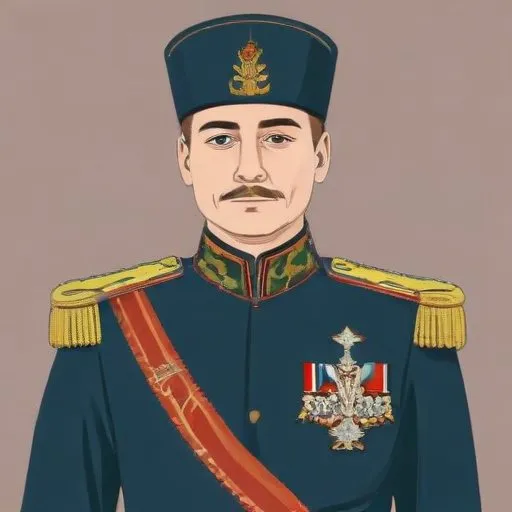
The youngest son of Paul I, he was a military leader and reformer who modernized the Russian army and established the Nikolaevskaya Akademija, a prestigious military academy. He's also known for his philanthropic efforts, particularly in education and healthcare.
Grand Duke Michael Pavlovich of Russia is renowned for his unwavering dedication to the military and his instrumental role in suppressing the Decembrist revolt following the sudden death of Alexander I. As the fourth son of Paul I of Russia and Sophie Dorothea of Wurttemberg, Michael Pavlovich was destined for greatness, and his actions would significantly impact the course of Russian history.
Born on 8 February 1798, in the Winter Palace, Russia, Michael Pavlovich was the youngest child and son of Tsar Paul I of Russia and his wife, Maria Feodorovna. He was the only one of his siblings to be born in the purple, meaning born while his father was Tsar. His godparents were his older brother, Alexander, and his sister, Alexandra, who stood in for their grandmother Princess Friederike of Brandenburg-Schwedt.
Michael Pavlovich was tutored by General I. M. Lamzdorf, but his mother, Maria Feodorovna, played a significant role in his education, teaching him science in an attempt to dissuade him from pursuing a military career. However, this effort was in vain, as Michael and his brother Nicholas I had a strong affinity for all things military. At the age of sixteen, Michael took part in the campaign against Napoleon, which would be a pivotal experience in shaping his future.
Following the sudden death of Alexander I, Michael Pavlovich played a crucial role in suppressing the Decembrist revolt. When news of the Tsar's demise reached him, Michael was in Warsaw. The next day, he left for Saint Petersburg with a letter from Grand Duke Konstantin, renouncing his right to the throne. Upon his arrival, he discovered that the oath of allegiance to Konstantin had already been sworn. Undeterred, he returned to Warsaw and attempted to convince his brother to come to the capital, but to no avail. Returning early on 14 December, he found that ranks of the artillery had already been formed, and he joined the effort to quell the uprising.
Throughout his life, Michael Pavlovich was driven by a strong sense of duty and loyalty to his family and country. His actions during the Decembrist revolt showcased his unwavering commitment to maintaining order and stability in Russia. Although he did not ascend to the throne, his influence on Russian history is undeniable, and his legacy continues to be felt to this day.
Grand Duke Michael Pavlovich of Russia's life was marked by his unrelenting dedication to the military and his country. His actions during the Decembrist revolt cemented his place in Russian history, and his legacy continues to inspire and fascinate to this day.
Born in 1868
The last emperor of Russia, ruling from 1894 to 1917, known for his poor leadership and decisions that led to the downfall of the Romanov dynasty and the rise of communism.
Born in 1818
Liberalizing reforms and abolishing serfdom in Russia, earning the nickname "Liberator."
Born in 1729
Empress of Russia from 1762 to 1796, she transformed her country into a major European power, modernizing its culture, politics, and economy through numerous reforms and conquests.
Born in 1759
The wife of Paul I of Russia, a powerful empress who played a significant role in shaping the country's politics and culture during the late 18th century. She was a patron of the arts and a strong advocate for education and women's rights.
Born in 1845
The Russian monarch who ruled from 1881 to 1894, known for his conservative and nationalistic policies, as well as his efforts to reform the Russian Empire's government and economy.
Born in 1868
The last emperor of Russia, ruling from 1894 to 1917, known for his poor leadership and decisions that led to the downfall of the Romanov dynasty and the rise of communism.
Born in 1845
The Russian monarch who ruled from 1881 to 1894, known for his conservative and nationalistic policies, as well as his efforts to reform the Russian Empire's government and economy.
