


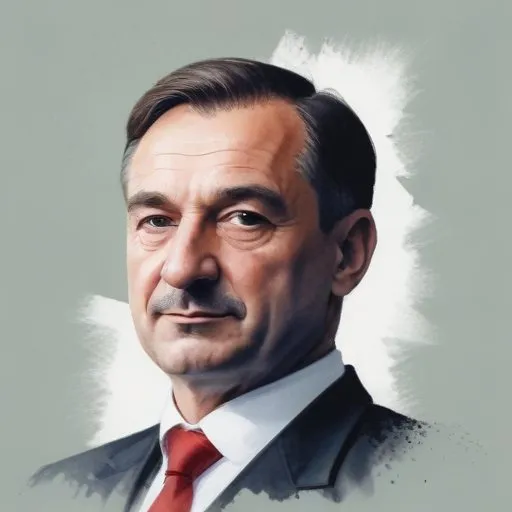
The 50th Prime Minister of Hungary, serving from 1975 to 1987, known for his economic reforms and attempts to decentralize the Hungarian economy. He played a significant role in shaping Hungary's transition from a socialist to a market-oriented economy.
György Lázár, a Hungarian Communist politician, is best known for his role as Chairman of the Council of Ministers from 1975 to 1987, making him one of the longest-serving prime ministers in Hungarian history. During his tenure, he played a significant role in shaping the country's economy, implementing policies that aimed to modernize and industrialize Hungary.
Lázár was born on September 15, 1924, in Isaszeg, Hungary, into a labor family. His father was a carpenter, and Lázár's original qualification was as an engineer. He worked as a technical draftsman from 1942 to 1944 before being forcibly conscripted into the paramilitary Levente organization during the Arrow Cross regime.
Lázár joined the Hungarian Communist Party (MKP) in 1945 and later became a member of its successor parties, including the Hungarian Working People's Party (MDP) and the Hungarian Socialist Workers' Party (MSZMP). He worked his way up the ranks, serving in various positions, including Deputy Head of Department and Head of Department at the National Planning Board (OT) from 1948 to 1970.
Lázár's leadership played a significant role in promoting economic growth and industrialization in Hungary. He implemented policies aimed at increasing production, improving infrastructure, and expanding foreign trade. During his tenure, Hungary experienced rapid economic growth, and Lázár's policies helped to raise the standard of living for many Hungarians.
Lázár's legacy extends beyond his economic policies. He was a strong believer in the importance of social welfare and education, and his government implemented policies aimed at improving access to healthcare, education, and social services.
In addition to his political achievements, Lázár's personal life was marked by significant milestones. He was taken prisoner of war in January 1945 and later joined the Hungarian combat units supported by the Red Army, fighting against the Nazi-backed Royal Hungarian Army in the western part of the country.
Lázár retired from politics in 1988, after serving as Prime Minister for over 12 years. He passed away on October 2, 2014, at the age of 90.
Lázár's political ideology was shaped by his commitment to socialism and communism. He believed in the importance of state ownership and control of key sectors of the economy, as well as the role of the government in promoting social welfare and equality.
Throughout his career, Lázár remained committed to the principles of Marxism-Leninism, and his policies were guided by the ideology of socialism and communism.
Lázár's legacy continues to shape Hungarian society and economy. His policies and initiatives helped to modernize and industrialize the country, laying the foundation for Hungary's economic growth and development in the decades that followed.
Today, Hungary continues to grapple with the challenges of economic development, and Lázár's policies and legacy serve as a reminder of the importance of government intervention in promoting economic growth and social welfare.
Born in 1912
A Hungarian mechanic-turned-politician who served as Prime Minister of Hungary from 1956 to 1988, known for his role in crushing the 1956 Hungarian Revolution and later introducing economic reforms.
Born in 1886
Led a communist government in Hungary after World War II, implementing Soviet-style policies and suppressing opposition. He played a key role in the country's post-war reconstruction and alignment with the Soviet Union.
Born in 1896
Led a reformist government in Hungary during the 1956 revolution, attempting to establish a multi-party system and withdraw from the Soviet-dominated Warsaw Pact. His efforts ultimately led to Soviet invasion and his execution.
65 Years Old
Hungary's 6th Prime Minister, a key figure in the country's transition to democracy, known for his economic reforms and leadership during the 2006 protests.
