


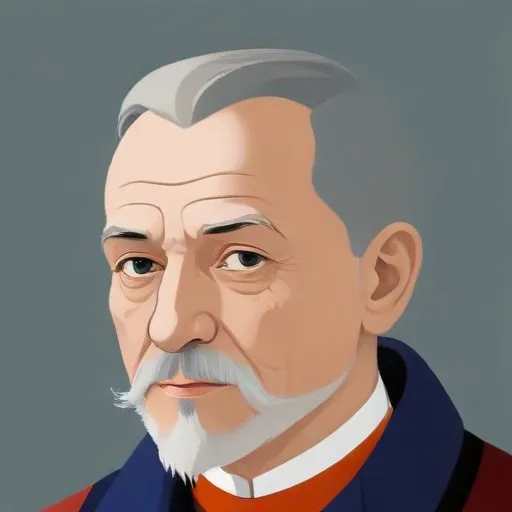
A Hungarian scholar and educator who developed the "Koi method" of teaching mathematics, emphasizing problem-solving and critical thinking. His approach has been widely adopted in Hungarian schools.
Gyula Koi is a renowned Hungarian legal scholar and lecturer, best known for his groundbreaking research in administrative law and theory of public administration. With over 480 published papers, he has made significant contributions to the field, earning him recognition as a leading expert in his domain.
Born on April 21, 1977, in Budapest, Hungary, Koi pursued his higher education at the Corvinus University of Budapest, where he graduated with a BA in public administration in 2002. He further honed his skills by earning an MAJD in Law from the University of Szeged in 2010, followed by sinology studies at Eötvös Loránd University from 2007 to 2009.
Koi's scholarly work has been widely recognized, with over 35 papers published in foreign languages, including Chinese, English, French, German, Serbian, Slovak, and Ukrainian. His work has garnered 508 citations to 105 publications, a testament to his significant contribution to the field of administrative law and public administration.
Gyula Koi's dedication to his craft has earned him a reputation as a leading authority in his field, and his work continues to inspire and inform scholars, policymakers, and practitioners worldwide.
Koi's contributions to Hungarian legal scholarship have been instrumental in shaping the country's administrative law and public administration landscape. His research has influenced policymakers, academics, and legal practitioners, ensuring a deeper understanding of the complex issues affecting Hungary and the European Union.
As a pioneering scholar, Gyula Koi's work has left an indelible mark on Hungarian legal scholarship, paving the way for future generations of researchers and policymakers to build upon his foundational work.
Born in 1802
A key figure in the Hungarian Revolution of 1848, leading the fight for independence from Austria and becoming a symbol of Hungarian nationalism. He's revered for his passionate oratory skills and unwavering dedication to his country's freedom.
Born in 1803
A Hungarian statesman who played a key role in the country's unification with Austria, creating the dual monarchy of Austria-Hungary in 1867. He's known for his efforts to establish a constitutional government and promote national unity.
Born in 1800
A Hungarian Romantic poet, known for his patriotic and nationalistic works that helped shape the country's literary identity. His poetry is still widely read and studied today.
