


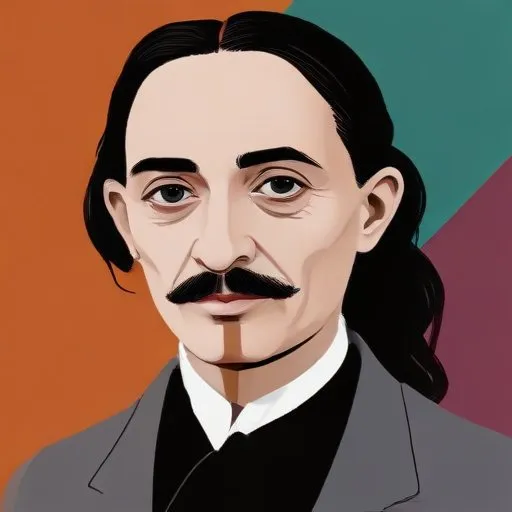
This Hungarian poet and activist was a key figure in the country's struggle for independence and is celebrated for his passionate and patriotic verses, which inspired a nation. He's often considered the national poet of Hungary.
Sándor Petőfi, a Hungarian poet and liberal revolutionary, is best known for his influential poem, "Nemzeti dal" (National Song), which is said to have sparked the Hungarian Revolution of 1848 against the Austrian Empire. His powerful words and dedication to the fight for independence have earned him the title of Hungary's national poet.
Born on January 1, 1823, in Kiskőrős, Kingdom of Hungary, Petőfi's family was of Slovak origin, and his birth certificate lists his name as Alexander Petrovics. His father, István Petrovics, was a village butcher and innkeeper, while his mother, Mária Hrúz, was a servant and laundress before her marriage. Despite their modest means, Petőfi's parents valued education and sent him to a lyceum, where he developed a passion for literature and poetry.
Petőfi's early writing career began with the publication of his first book of poetry, "Versek" (Poems), in 1842. However, it was his poem "Nemzeti dal" that brought him national attention and cemented his role as a leading figure in the Hungarian Revolution. The poem's powerful message of freedom and independence resonated with the Hungarian people, inspiring many to take up arms against the Austrian Empire.
In addition to his poetry, Petőfi was also an influential journalist and editor, working for several publications, including the Hungarian newspaper "Pesti Hírlap". His writing often addressed social and political issues, earning him both praise and criticism from his contemporaries.
Petőfi's poetry and writing often reflected his liberal and democratic ideals. He believed in the power of the people and the importance of individual freedom and equality. His poetry often expressed a sense of national pride and a desire for Hungarian independence from the Austrian Empire.
Petőfi's impact on Hungarian society cannot be overstated. His poetry and activism helped to inspire a generation of Hungarians to fight for their independence and freedom. Today, he is remembered as a national hero, and his poetry is still widely studied and admired in Hungary.
Sándor Petőfi's legacy extends far beyond his poetry and activism. He is remembered as a symbol of Hungarian resistance and a champion of freedom and democracy. His poetry continues to inspire generations of Hungarians, and his influence can be seen in many aspects of Hungarian culture and society.
In conclusion, Sándor Petőfi's life and work had a profound impact on Hungarian history and society. His poetry and activism continue to inspire and influence Hungarians to this day, cementing his place as Hungary's national poet.
Born in 1790
A Hungarian poet, critic, and politician who played a key role in shaping the country's literary and cultural identity, and is best known for writing the lyrics to the Hungarian national anthem.
Born in 1900
A Hungarian journalist and author, known for his lyrical and introspective novels that explore the decline of the Austro-Hungarian Empire and the rise of fascism. His works are celebrated for their poetic prose and nuanced character studies.
Born in 1905
A Hungarian poet and educator, known for his powerful and expressive works that explored themes of social justice, love, and the human condition. His poetry is celebrated for its lyricism and depth.
Born in 1803
A Hungarian statesman who played a key role in the country's unification with Austria, creating the dual monarchy of Austria-Hungary in 1867. He's known for his efforts to establish a constitutional government and promote national unity.
Born in 1802
A key figure in the Hungarian Revolution of 1848, leading the fight for independence from Austria and becoming a symbol of Hungarian nationalism. He's revered for his passionate oratory skills and unwavering dedication to his country's freedom.
