


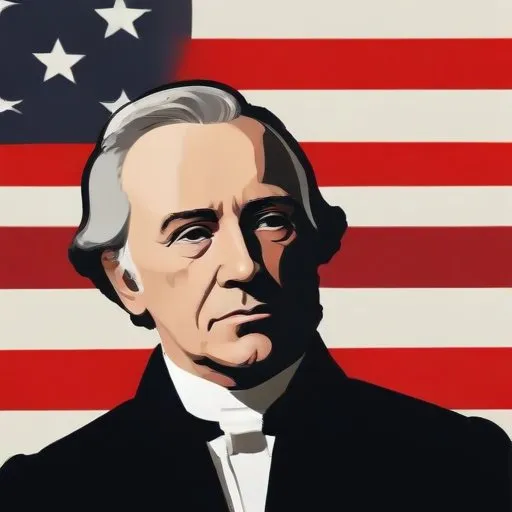
A Missouri Supreme Court judge and governor who played a crucial role in keeping the state in the Union during the American Civil War. He's most known for his moderate stance on slavery and states' rights.
Hamilton Rowan Gamble, a stalwart figure in American jurisprudence, is renowned for his courageous dissent in the landmark Dred Scott case of 1852, where he defied the majority opinion of the Missouri Supreme Court. This pivotal moment in American history showcased Gamble's unwavering commitment to the principles of justice and equality, earning him a revered place in the annals of American legal history.
Born on November 29, 1798, in Winchester, Virginia, Gamble was the youngest of seven children to Scots-Irish immigrants Joseph and Anne Hamilton Gamble. He received his early education locally and later attended Hampden-Sydney College, a Presbyterian seminary, before reading law with an established firm and being accepted to the Virginia bar in 1817.
In 1818, Gamble relocated to St. Louis, Missouri, where he joined his older brother Archibald Gamble, an attorney and clerk of the St. Louis Circuit Court. He practiced law in Franklin, Missouri, before becoming prosecuting attorney of the Circuit Court of Howard County, Missouri. In 1824, Governor Frederick Bates appointed Gamble as Missouri Secretary of State, a role that catapulted him to statewide prominence.
Gamble's jurisprudential expertise was marked by his involvement in several high-profile cases, including freedom suits, where enslaved individuals challenged their captivity. His seminal dissent in the Dred Scott case, which argued against the majority opinion that upheld slavery, demonstrated his commitment to the principle of justice and equality. This courageous stance solidified Gamble's reputation as a champion of human rights and earned him a place among the most revered jurists of his time.
During the American Civil War, Gamble was appointed Governor of Missouri by a Constitutional Convention after Union forces captured the state capital, Jefferson City, and deposed the elected governor, Claiborne Jackson. His wartime leadership demonstrated his unwavering commitment to preserving the Union and ending the institution of slavery.
Gamble's unyielding dedication to justice, equality, and human rights has left an indelible mark on American jurisprudence and politics. His courageous dissent in the Dred Scott case continues to inspire generations of legal scholars, activists, and politicians. As a testament to his enduring legacy, Gamble's name has become synonymous with moral courage and unwavering commitment to the principles of justice and equality.
Gamble's life and work were shaped by the tumultuous era of American history, marked by the struggle for slavery's abolition and the nation's westward expansion. His commitment to justice and equality continues to inspire and inform American jurisprudence, politics, and society, cementing his place as a beacon of moral courage and unwavering dedication to the principles of human rights and dignity.
Born in 1809
Led the United States through its Civil War and ultimately abolished slavery, leaving a lasting legacy in American history.
Born in 1807
Led the Confederate States Army during the American Civil War, surrendering to Union forces at Appomattox, marking the war's effective end.
Born in 1822
Led the Union Army to victory in the Civil War and later became President, known for issuing the Emancipation Proclamation and strengthening federal authority.
Born in 1808
The President of the Confederate States of America during the American Civil War, leading the secessionist movement and fighting to preserve slavery. He's infamous for his role in the Civil War and its aftermath.
Born in 1824
A Confederate general during the American Civil War, he's renowned for his unconventional tactics and bravery, earning him a legendary status among military historians.
Born in 1821
A Confederate general during the American Civil War, later serving as a diplomat and ambassador to Turkey, known for his military strategies and post-war reconciliation efforts.
Born in 1818
A Confederate general who played a pivotal role in the American Civil War, particularly during the Battle of Fort Sumter, and is often credited with starting the war.
Born in 1815
Led the Union Army to victory in the Battle of Gettysburg, a turning point in the American Civil War, and later oversaw the construction of the Washington Aqueduct.
