


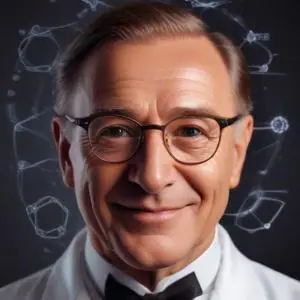
German physician and biochemist who discovered the citric acid cycle, a crucial process by which cells generate energy from food, revolutionizing our understanding of cellular metabolism.
Hans Adolf Krebs is best known for his groundbreaking discovery of the citric acid cycle, also known as the Krebs cycle or tricarboxylic acid (TCA) cycle, which revolutionized our understanding of cellular respiration. This fundamental process is essential for energy production in living organisms, and Krebs' work has had a profound impact on various fields, including biochemistry, medicine, and nutrition.
Hans Adolf Krebs was born on August 25, 1900, in Hildesheim, Germany, to a Jewish family. He developed an interest in chemistry and medicine at a young age, which led him to pursue a degree in medicine from the University of Göttingen. Krebs later moved to Berlin, where he worked under the guidance of renowned biochemist Otto Heinrich Warburg, who would later become a Nobel laureate.
In the 1930s, Krebs began researching the metabolism of fats and carbohydrates, which ultimately led to the discovery of the citric acid cycle. Through his experiments, Krebs identified the key steps involved in the breakdown of acetyl-CoA, a molecule derived from the oxidation of carbohydrates, fats, and proteins. This breakthrough finding was first published in 1937 and has since become a cornerstone of cellular respiration.
Krebs' pioneering work was recognized with numerous awards, including the Nobel Prize in Physiology or Medicine in 1953, which he shared with Fritz Albert Lipmann. He also received the Copley Medal in 1961 and was elected a Fellow of the Royal Society in 1947.
Krebs made significant contributions to various fields, including:
Krebs' work has had a profound impact on our understanding of cellular respiration, metabolism, and energy production. His discovery of the citric acid cycle has led to significant advances in:
Krebs was forced to flee Nazi Germany in 1933 due to his Jewish heritage and eventually settled in Cambridge, England. He became a British citizen in 1939 and served in the Royal Army Medical Corps during World War II. Krebs died on November 22, 1981, at the age of 81, leaving behind a legacy of pioneering research and discovery.
Krebs was known for his rigorous scientific approach and emphasis on experimentation. He believed in the importance of basic research and its potential to lead to groundbreaking discoveries. Krebs' work embodies the principles of scientific inquiry and demonstrates the power of human curiosity and innovation.
Hans Adolf Krebs' discovery of the citric acid cycle has had a lasting impact on our understanding of cellular respiration and metabolism. His work has paved the way for significant advances in various fields and continues to inspire new generations of scientists and researchers. Krebs' legacy serves as a testament to the power of human ingenuity and the importance of basic scientific research.
Born in 1883
A German physiologist and physician who discovered that cancer cells generate energy through anaerobic metabolism, earning him the Nobel Prize in Physiology or Medicine in 1931. His work laid the foundation for modern cancer research.
98 Years Old
A renowned biochemist who made significant contributions to our understanding of cellular metabolism and was a pioneer in the field of bioenergetics.
Born in 1918
Pioneering biochemist who discovered the mechanism of DNA replication and was awarded the Nobel Prize in Physiology or Medicine in 1959 for his groundbreaking work on nucleic acid synthesis.
Born in 1905
A pioneering biochemist who discovered the mechanism of RNA synthesis, earning a Nobel Prize in Physiology or Medicine in 1959. His work laid the foundation for our understanding of genetic code and protein synthesis.
Born in 1881
Developed groundbreaking theories on polymers, revolutionizing the field of organic chemistry, and was awarded the Nobel Prize in Chemistry in 1953.
Born in 1903
A German biochemist and academic who discovered the sex hormones estrogen and testosterone, and was awarded the Nobel Prize in Chemistry in 1939.
