


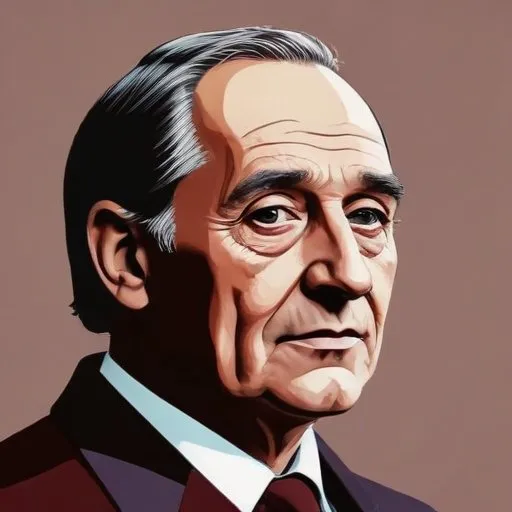
A 17th-century poet and politician who wrote influential works that shaped German literature and served as a prominent figure in the Thirty Years' War.
Hans Erasmus Amann, Freiherr von Abschatz, was a renowned German statesman and poet of the 17th century, known for his remarkable contributions to the Second Silesian School of poetry and his distinguished career in politics.
Born on February 4, 1646, in Wrbitz, Lower Silesia, Amann's life took a drastic turn when his parents passed away at a young age. Despite this, he went on to attend college in Liegnitz and later studied law at the universities of Strasbourg and Leyden.
Following his studies, Amann embarked on a three-year journey to Belgium, France, and Italy, which broadened his perspectives and laid the foundation for his future endeavors.
Returning to Silesia at the age of 23, Amann assumed the administration of his estate and married Anna von Hund in 1669. His exceptional managerial skills and fortunate personal life earned him recognition, and he soon entered the realm of politics.
Amann's talent in administration led to his appointment as a representative to the imperial court at Vienna, first as a syndic for the Duchy of Liegnitz and later as a representative for all Silesian lands. Emperor Leopold I honored him with the title of Baron (Freiherr) in recognition of his service.
In 1679, Amann was elected as a permanent deputy of Legnica to the diet of the Silesian sovereigns, the so-called Frstentage in Breslau. His dedication to public service earned him the respect of his fellow countrymen, and he was aptly described as an "honest man in his fatherland" on his tombstone.
Amann was an integral part of the Second Silesian School of poetry, alongside notable writers such as Daniel Casper von Lohenstein, Andreas Gryphius, and Christian Hoffmann von Hoffmannswaldau. His poetry showcased his mastery of language and his ability to convey complex emotions.
Amann was also an accomplished translator, renowned for his accurate translation of Il pastor fido. His close friendship with Lohenstein, a fellow poet, further underscored his significance in the literary circle.
Hans Erasmus Amann's remarkable life and achievements have left an indelible mark on the world of poetry and politics. His contributions to the Second Silesian School of poetry and his distinguished political career have cemented his position as a notable figure in German history.
In conclusion, Hans Erasmus Amann's remarkable life, characterized by his dedication to poetry and politics, serves as an inspiration to generations to come, reminding us of the significance of living a life of purpose and integrity.
Born in 1749
A German literary giant who penned iconic works like "Faust" and "The Sorrows of Young Werther", shaping the Romantic movement and influencing countless writers.
Born in 1759
A renowned poet and playwright who crafted influential works that explored the human condition, morality, and the struggle for freedom, leaving a lasting impact on German literature.
53 Years Old
A Jamaican artist who blends dancehall, reggae, and pop to create infectious hits, known for his energetic stage presence and chart-topping singles like "Gimme the Light" and "Baby Boy".
Born in 1776
A German Romantic-era mastermind who crafted dark, fantastical tales and composed mesmerizing music, leaving an indelible mark on literature and classical music.
Born in 1778
Romantic-era writer of fantastical and often dark tales, exploring themes of love, death, and the supernatural. His works are considered precursors to modern fantasy literature.
Born in 1785
A 19th-century German literary figure, known for her romantic and often fantastical writings, as well as her musical compositions and illustrations. Her works often explored themes of love, nature, and social commentary.
Born in 1781
A German botanist and poet who traveled the world, discovering new plant species and writing romantic poetry that explored the human condition.
