


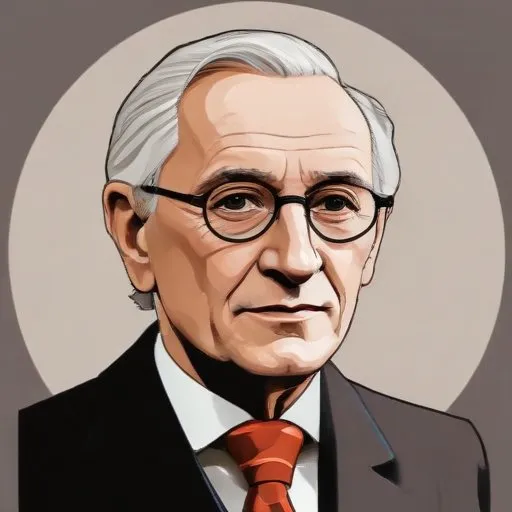
A prominent historian and academic who specialized in modern German history, particularly the German Empire and Weimar Republic, and is known for his critical approach to historical analysis.
Hans-Ulrich Wehler is renowned for his pivotal role in promoting social history through the Bielefeld School, a paradigm shift in historical analysis that focuses on sociocultural developments rather than political aspects. Through his critical studies of 19th-century Germany, Wehler has left an indelible mark on the field of history.
Born on September 11, 1931, in Freudenberg, Westphalia, Wehler's academic journey began in Cologne, Bonn, and later at Ohio University in the United States, where he received a Fulbright scholarship. During his time in the US, he worked as a welder and truck driver in Los Angeles for six months, an experience that would later influence his perspective on American imperialism.
Wehler's PhD dissertation, completed in 1960 under the supervision of Theodor Schieder at the University of Cologne, examined social democracy and the nation-state in Germany between 1840 and 1914. His postdoctoral thesis on Bismarck and imperialism paved the way for his academic career. Wehler's habilitation project on American imperialism between 1865 and 1900, supported by the American Council of Learned Societies, led to two seminal books.
As a professor, Wehler taught at the University of Cologne (1968-1970), the Free University of Berlin (1970-1971), and Bielefeld University (1971-1996). Alongside Jürgen Kocka and Reinhart Koselleck, he founded the Bielefeld School, a historical analysis approach that emphasizes sociocultural developments over political aspects. This shift in focus led to a deeper understanding of German society in the 19th and 20th centuries.
As the editor of the journal Geschichte und Gesellschaft from 1975, Wehler played a crucial role in promulgating the Bielefeld School's approach. This school of thought has had a profound impact on the field of history, encouraging historians to adopt a more nuanced and multidisciplinary approach to their research.
In 2003, Wehler was awarded the NRW State Prize, a testament to his contributions to the field of history.
Wehler married Renate Pfitsch in 1958 and had three children with her. His legacy extends beyond his academic accomplishments, leaving an indelible mark on the field of history and inspiring future generations of historians.
Wehler's passing on July 5, 2014, marked the end of an era, but his contributions to social history and the Bielefeld School continue to shape the field of history, ensuring his legacy endures.
Born in 1817
A renowned historian and scholar who wrote extensively on ancient Rome, earning a Nobel Prize in Literature for his monumental work "The History of Rome".
Born in 1900
A German philosopher and scholar who developed philosophical hermeneutics, a methodology for interpreting texts and understanding human experience, and is known for his work on the importance of language and tradition in shaping our understanding of the world.
97 Years Old
A prominent thinker who developed the concept of "communicative action" and explored the relationships between power, language, and social structures, influencing modern critical theory and sociology.
Born in 1923
A German historian and philosopher who reinterpreted the rise of Nazism and fascism, sparking controversy with his views on the Holocaust and its relationship to communist atrocities.
Born in 1918
A German leader who served as Chancellor from 1974 to 1982, known for his pragmatic and socially liberal policies, and his key role in shaping the European Union. He was also a respected economist and published author.
