


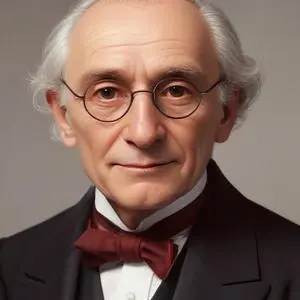
A renowned historian and scholar who wrote extensively on ancient Rome, earning a Nobel Prize in Literature for his monumental work "The History of Rome".
Theodor Mommsen is renowned for his monumental work, "The History of Rome", a masterpiece that earned him the Nobel Prize in Literature in 1902. This German classical scholar, historian, jurist, journalist, and politician left an indelible mark on the world of classical studies, and his contributions continue to inspire and educate scholars to this day.
Born on November 30, 1817, in Garding, Duchy of Schleswig, Mommsen grew up in an environment that fostered a love for learning. His father, a Lutheran minister, encouraged his son's intellectual pursuits, and Mommsen studied mostly at home before attending the Gymnasium Christianeum in Altona for four years.
Mommsen's academic journey took him to the University of Kiel, where he studied jurisprudence from 1838 to 1843 and earned his degree in Roman Law. During this period, he shared a room with Theodor Storm, a poet who would later gain fame in his own right. The two friends, along with Mommsen's brother Tycho, published a collection of poems called "Liederbuch dreier Freunde".
A royal Danish grant enabled Mommsen to travel to France and Italy, where he immersed himself in the study of classical Roman inscriptions. This experience laid the foundation for his future works, including "The History of Rome", a comprehensive and authoritative account of the Roman Empire.
During the revolution of 1848, Mommsen worked as a war correspondent in Rendsburg, advocating for the German annexation of Schleswig-Holstein and constitutional reform. His outspoken views led to his forced exile, and he took up a professorship of law at the University of Leipzig in 1848.
Mommsen's magnum opus, "The History of Rome", is a testament to his dedication and scholarship. The work, written over the course of several decades, is a masterpiece of historical writing, offering unparalleled insights into the Roman Empire.
Mommsen's contributions extended beyond the realm of classical studies. His works on Roman law and the law of obligations had a profound impact on the German civil code, and his influence can still be seen in modern legal systems.
In recognition of his literary achievements, Mommsen received the Nobel Prize in Literature in 1902. This prestigious award cemented his status as one of the greatest classicists of the 19th century.
Theodor Mommsen's legacy is multifaceted and far-reaching. His tireless efforts to preserve and promote classical knowledge have inspired generations of scholars, and his works continue to be studied and revered today.
As we reflect on Mommsen's life and achievements, we are reminded of the power of dedication, perseverance, and intellectual curiosity. His remarkable journey serves as a testament to the enduring importance of classical studies and the impact one person can have on the world.
Born in 1770
A German philosopher and academic who developed a comprehensive and systematic philosophy that emphasized the unity of all things and the dialectical process of thesis, antithesis, and synthesis. His ideas have had a profound impact on modern thought, influencing fields such as philosophy, politics, and art.
Born in 1788
A pessimistic philosopher who wrote about the human condition, emphasizing the struggles and sufferings of life, and is famous for his concept of the "will to life".
Born in 1724
Developed influential philosophical frameworks, such as the Critique of Pure Reason, that shaped modern Western thought on ethics, morality, and human understanding.
Born in 1749
A German literary giant who penned iconic works like "Faust" and "The Sorrows of Young Werther", shaping the Romantic movement and influencing countless writers.
Born in 1759
A renowned poet and playwright who crafted influential works that explored the human condition, morality, and the struggle for freedom, leaving a lasting impact on German literature.
Born in 1729
A prominent Enlightenment thinker, he's known for his influential writings on philosophy, literature, and theology, which helped shape modern German culture. He's also credited with developing the concept of dramatic irony in literature.
Born in 1797
A 19th-century literary mastermind who penned poignant poetry and biting social commentary, known for his witty satire and romantic verses that still resonate today.
