


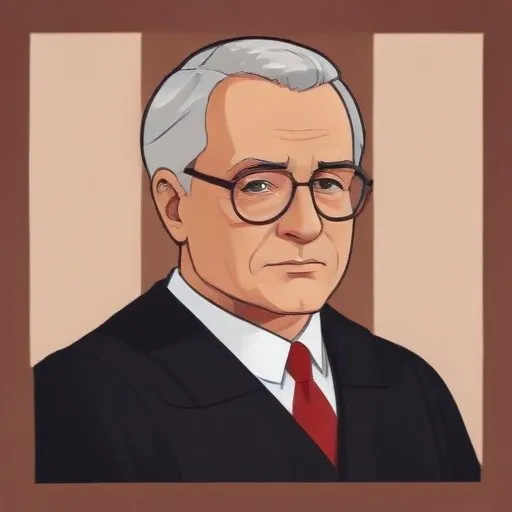
A judge who presided over the trial of Black Panther Party founder Huey P. Newton, known for his fairness and bravery in the face of death threats.
Harold Haley, a renowned Superior Court judge in Marin County, California, will forever be etched in the annals of history for his unwavering dedication to justice and his selfless sacrifice during a dramatic courtroom hostage situation that took his life in 1970.
At the height of his career, Judge Haley was presiding over a high-profile trial when a group of assailants, led by Jonathan Jackson, stormed into his courtroom, taking him and several others hostage in a desperate bid for freedom.
Born on November 14, 1904, in San Rafael, California, Harold Haley graduated from San Rafael High School before pursuing his law degree from St. Ignatius College (later known as the University of San Francisco), which he achieved in 1928.
With an unwavering commitment to the legal profession, Haley served as a San Rafael city attorney and later as a Marin County district attorney. In 1956, he was appointed as a municipal court judge by California Governor Goodwin Knight, a role he fulfilled with distinction. Nine years later, Governor Pat Brown elevated him to the superior court.
In 1933, Judge Haley married his high school classmate, Gertrude Ahern, at Mission San Rafael Arcángel, and the couple was blessed with three daughters. Interestingly, his niece, Maureen, went on to marry former Marin County assistant district attorney and Superior Court judge Gary Thomas, who was left paralyzed in the same shooting spree that claimed Haley's life.
On that fateful day, August 7, 1970, Jonathan Jackson brought guns into Judge Haley's courtroom, where San Quentin inmate James McClain was on trial. The ensuing drama unfolded as McClain was freed, along with two other San Quentin inmates, Ruchell Magee and William Christmas, who were present as witnesses.
Jackson and the prisoners took Judge Haley, Thomas, and three female jurors hostage and attempted to escape. Tragically, Haley, Jackson, McClain, and Christmas lost their lives as the abductors attempted to flee the courthouse. Haley was struck by fire from a sawed-off shotgun that had been fastened to his neck with adhesive tape by the abductors.
Judge Haley's courageous stance in the face of danger and his ultimate sacrifice have inspired generations of legal professionals, law enforcement officers, and ordinary citizens alike. His dedication to justice and his unwavering commitment to the rule of law serve as a beacon of hope in a world often marred by violence and chaos.
Despite the tragic circumstances of his demise, Judge Haley's legacy lives on, reminding us of the importance of standing up for what is right, even in the face of overwhelming adversity.
In the words of Judge Haley's niece, Maureen, "He died as he lived, with dignity and courage."
As we reflect on the life and legacy of Harold Haley, we are reminded of the profound impact one person can have on the world around them. May his story continue to inspire us to stand up for justice, to stand strong in the face of adversity, and to never waver in our commitment to the values that make us human.
Born in 1891
The 14th Chief Justice of the United States, a jurist and politician who led the Supreme Court through a transformative era of civil rights and social change, issuing landmark rulings like Brown v. Board of Education.
Born in 1907
The 15th Chief Justice of the United States, leading the Supreme Court from 1969 to 1986, known for his conservative stance and landmark decisions on abortion and capital punishment.
Born in 1898
A Supreme Court Justice who championed individual rights and environmental protection, leaving a lasting impact on American law and conservation.
Born in 1886
A U.S. Supreme Court Justice who served for 34 years, known for his strong support of individual liberties and First Amendment rights.
Born in 1882
A renowned Supreme Court Justice and Harvard Law professor who played a significant role in shaping American law and policy, particularly in the areas of civil liberties and judicial restraint.
Born in 1892
A renowned lawyer, judge, and politician who served as the 57th US Attorney General and played a key role in the Nuremberg Trials, prosecuting Nazi war criminals.
Born in 1872
The 12th Chief Justice of the United States, a prominent lawyer and jurist, is most known for his significant contributions to shaping the Supreme Court's decisions and upholding the Constitution. He played a crucial role in establishing the Court's liberal wing during the New Deal era.
Born in 1862
A prominent lawyer and politician who served as the 44th Secretary of State, known for his influential decisions and diplomatic efforts in shaping international relations. He played a key role in resolving the Mexican Revolution crisis.
