


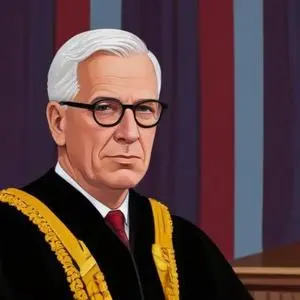
The 14th Chief Justice of the United States, a jurist and politician who led the Supreme Court through a transformative era of civil rights and social change, issuing landmark rulings like Brown v. Board of Education.
Earl Warren, the 14th Chief Justice of the United States, is renowned for presiding over a monumental shift in American constitutional jurisprudence, earning him a reputation as one of the most influential Supreme Court justices in the country's history. His landmark decisions in cases like Brown v. Board of Education, Reynolds v. Sims, Miranda v. Arizona, and Loving v. Virginia continue to have a profound impact on American society.
Warren's illustrious career in public service spanned over three decades, starting with his election as the Attorney General of California in 1938. He went on to serve as the 30th Governor of California from 1943 to 1953, making him the only governor to be elected for three consecutive terms. His leadership during this period was marked by significant growth and development in the state.
Warren's appointment as the Chief Justice of the United States in 1953 marked the beginning of a new era in American judicial history. The Warren Court, as it came to be known, delivered a series of landmark decisions that expanded individual rights, promoted social justice, and redefined the role of the judiciary in American democracy. Some of the most notable cases include:
In 1963, President Lyndon B. Johnson tasked Warren with leading the Warren Commission, a presidential commission established to investigate the assassination of President John F. Kennedy. The commission's findings, although controversial, provided some closure to a grieving nation.
Warren's legacy is not without its criticisms. His support for the forced removal and internment of over 100,000 Japanese Americans during World War II remains a contentious issue. However, his contributions to the advancement of social justice, individual rights, and the rule of law are undeniable. As a jurist, politician, and leader, Earl Warren left an indelible mark on American history.
Warren was born on March 19, 1891, in Los Angeles, California, and grew up in Bakersfield. He graduated from the University of California, Berkeley, School of Law, and began his legal career in Oakland. He served as a deputy district attorney for Alameda County in 1920 and was appointed district attorney in 1925.
"A republic, if you can keep it, is about the only thing that can keep you." - Earl Warren
Earl Warren's life and legacy serve as a testament to the power of visionary leadership and the importance of upholding the principles of justice, equality, and freedom. His contributions to American history continue to inspire future generations of leaders, lawyers, and citizens.
Born in 1886
A U.S. Supreme Court Justice who served for 34 years, known for his strong support of individual liberties and First Amendment rights.
Born in 1882
A renowned Supreme Court Justice and Harvard Law professor who played a significant role in shaping American law and policy, particularly in the areas of civil liberties and judicial restraint.
Born in 1898
A Supreme Court Justice who championed individual rights and environmental protection, leaving a lasting impact on American law and conservation.
Born in 1872
The 12th Chief Justice of the United States, a prominent lawyer and jurist, is most known for his significant contributions to shaping the Supreme Court's decisions and upholding the Constitution. He played a crucial role in establishing the Court's liberal wing during the New Deal era.
Born in 1862
A prominent lawyer and politician who served as the 44th Secretary of State, known for his influential decisions and diplomatic efforts in shaping international relations. He played a key role in resolving the Mexican Revolution crisis.
Born in 1856
A pioneering lawyer and jurist who championed individual rights and freedoms, shaping the course of American law and democracy through landmark Supreme Court decisions.
Born in 1841
A renowned Supreme Court Justice, he penned influential opinions that shaped American law, particularly in the areas of free speech and judicial restraint.
Born in 1908
A trailblazing lawyer and civil rights champion who broke racial barriers in the US justice system, serving as the first African American on the Supreme Court. He fought tirelessly for equality and justice, leaving a lasting impact on American history.
