


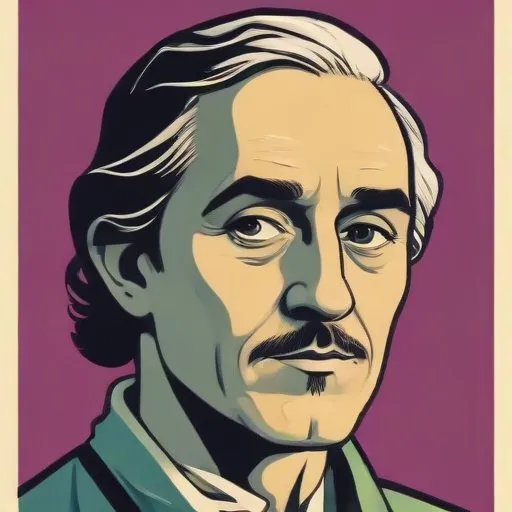
A Beat Generation poet and novelist, known for his vivid and unapologetic portrayals of gay life and his unique blend of mysticism and eroticism. His work explores the intersection of identity, desire, and spirituality.
Harold Norse, the American writer, is best known for his bold and unflinching poetry that captured the essence of everyday life in the American idiom. As one of the leading figures of the Beat Generation, Norse's work challenged traditional verse forms, embracing a more direct, conversational language that resonated with the rebellious spirit of the 1950s and 60s.
Born Harold Rosen on July 6, 1916, in Brooklyn, New York, to a Lithuanian Jewish immigrant mother, Norse's early life was marked by uncertainty. However, his passion for writing and literature led him to edit the literary magazine at Brooklyn College, where he earned his B.A. in 1938. It was during this period that he adopted the surname "Norse" by rearranging the letters of his original surname, Rosen.
Norse's association with W.H. Auden's inner circle, which included Chester Kallman, played a significant role in shaping his literary career. However, it was his connection with William Carlos Williams that had a profound impact on his writing style. Williams, who rated Norse as the best poet of his generation, encouraged him to experiment with new forms of poetry.
Norse's-first book of poems, The Undersea Mountain, was published in 1953. This was followed by a string of publications in esteemed literary journals, including Poetry, The Saturday Review, and The Paris Review. His experimental cut-up novel, Beat Hotel, penned in 1960 while living in Paris with William S. Burroughs, Allen Ginsberg, and Gregory Corso, further cemented his reputation as a bold and innovative writer.
Norse's love for travel and cultural immersion took him to Italy, where he lived from 1954 to 1959. He later traveled to Tangier, where he stayed with Jane and Paul Bowles. His time in Venice, California, brought him into close proximity with Charles Bukowski, another prominent figure of the Beat Generation. In 1972, Norse settled in San Francisco's Mission District, where he spent the last 35 years of his life.
In his memoir, Memoirs of a Bastard Angel, Norse offers a candid account of his life and literary career, which intersected with some of the most iconic figures of the 20th century, including Auden, Isherwood, Cummings, Williams, Baldwin, Thomas, Burroughs, Ginsberg, Ferlinghetti, Bowles, Bukowski, Graves, and Nin.
Harold Norse's unwavering commitment to his art and his unapologetic voice have left an indelible mark on American literature. His legacy continues to inspire generations of writers and artists who value creativity, experimentation, and the freedom to express oneself unapologetically.
Norse's contributions to American literature have been recognized with numerous awards and honors, including the Josephine Miles Literature Award and the American Book Award.
Norse's poetry and prose are characterized by a strong sense of rebellion and nonconformity. His writing embodies a spirit of freedom, encouraging individuals to question authority and challenge traditional norms.
Through his work, Norse celebrates the beauty of everyday life, elevating the mundane to an art form. His poetry serves as a testament to the power of language, demonstrating its ability to transform and transcend the human experience.
Born in 1926
A leading figure of the Beat Generation, known for his poetry that explores themes of nonconformity, free expression, and social justice. His iconic poem "Howl" is a classic of American literature.
Born in 1922
Pioneering figure of the Beat Generation, known for spontaneous, confessional, and poetic writings that captured the essence of American counterculture in the 1950s and 60s.
Born in 1914
A pioneering figure of the Beat Generation, known for experimental and provocative works that blended fiction and reality, pushing boundaries of literature and art.
Born in 1919
A Beat Generation icon who co-founded the legendary City Lights Bookstore, a hub for counterculture and free speech, and penned poetry that captured the spirit of rebellion and nonconformity.
96 Years Old
Beat poet of the 1950s and 60s, known for his spontaneous, conversational style and rebellious, nonconformist spirit. His poetry often explored themes of alienation, social disillusionment, and the search for authenticity.
Born in 1926
A charismatic figure of the Beat Generation, known for his spontaneous and free-flowing writing style, which greatly influenced the development of American literature.
Born in 1926
A prominent figure in the New York School of poets, known for his spontaneous, conversational style and poems that capture the essence of urban life and the human experience.
