


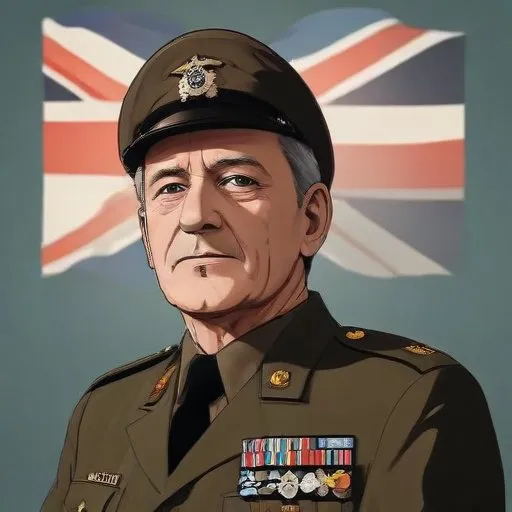
Led the Australian Imperial Force during World War I, playing a crucial role in the Sinai and Palestine Campaign, and later became the first Australian to attain the rank of field marshal.
General Sir Harry Chauvel is renowned for being the first Australian to attain the rank of lieutenant general and later general, and the first to lead a corps. He is celebrated for his remarkable military career, particularly for his leadership during the First World War, where he commanded the Desert Mounted Corps, achieving one of the most decisive victories and fastest pursuits in military history.
Born on 16 April 1865, Chauvel was the son of a grazier. He was commissioned as a second lieutenant in the Upper Clarence Light Horse in 1886, a unit organized by his father. Later, in 1890, he was commissioned as a second lieutenant in the Queensland Mounted Infantry, where he saw service during the 1891 Australian shearers' strike.
Chauvel's military prowess was evident during the Boer War, where he commanded one of two companies of Queensland Mounted Infantry that were Queensland's initial contribution to the war. After the war, he was closely involved with the training of the Australian Light Horse.
Promoted to colonel in 1913, Chauvel became the Australian representative on the Imperial General Staff. However, the First World War broke out before he could take up his appointment in the United Kingdom. He arranged for the Australian Imperial Force to be diverted to Egypt, where he joined his new command, the 1st Light Horse Brigade, in December 1914.
Chauvel's leadership skills were put to the test during the Gallipoli Campaign, where he assumed responsibility for some of the most dangerous parts of the line. He took charge of the 1st Division in November 1915 and later became commander of the Anzac Mounted Division in March 1916.
Under his command, the Anzac Mounted Division achieved several victories, including the Battle of Romani in August 1916, the Battle of Magdhaba in December 1916, and nearly winning the First Battle of Gaza in March 1917. These victories demonstrated Chauvel's exceptional leadership and tactical skills, earning him recognition as one of the most successful commanders of the war.
General Sir Harry Chauvel's military achievements have had a lasting impact on the Australian Imperial Force and the country as a whole. He is remembered as a visionary leader who played a significant role in shaping Australia's military history.
Today, Chauvel is celebrated as a national hero, and his legacy continues to inspire Australians. His remarkable military career serves as a testament to his bravery, leadership, and dedication to his country.
"The Australian soldier is a fighter, and he will fight as long as he has a weapon in his hand and a horse to ride."
This quote aptly sums up Chauvel's unwavering faith in the Australian soldier and his commitment to the war effort.
Chauvel's military achievements must be viewed within the context of the First World War, a global conflict that had far-reaching consequences for the world. His leadership played a significant role in shaping the outcome of the war and Australia's contribution to it.
Today, Chauvel's legacy is celebrated through various memorials, museums, and historical sites across Australia, ensuring that his remarkable military career and leadership are never forgotten.
Born in 1865
Led a corps of Australian troops to victory in World War I, and later became a prominent engineer, overseeing major infrastructure projects in Melbourne.
Born in 1862
The 5th Prime Minister of Australia, a key figure in the country's early 20th-century politics, known for his role in shaping Australia's social and economic landscape. He played a crucial part in establishing the country's old-age pension and maternity allowance systems.
Born in 1862
A carpenter-turned-politician who served as Australia's 7th Prime Minister, known for his strong leadership during World War I and his role in shaping the country's post-war development.
Born in 1894
The 12th Prime Minister of Australia, a lawyer-turned-politician who played a crucial role in shaping the country's post-war economy and foreign policy, and is often credited with establishing the modern Australian identity.
Born in 1885
Led the country through World War II, implementing policies to defend Australia and its economy. He's also known for his leadership during the country's transition from British to American influence.
Born in 1890
The 15th Prime Minister of Australia, serving for just eight days in 1945, known for being the shortest-serving prime minister in Australian history. He was also a prominent educator and politician.
Born in 1894
The 13th Prime Minister of Australia, serving from 1941, known for his brief but significant term during World War II, and his role in shaping the country's economy.
Born in 1881
Early Hollywood pioneer who directed over 500 films and was a key figure in the development of the film industry. Known for his prolific output and innovative filmmaking techniques.
