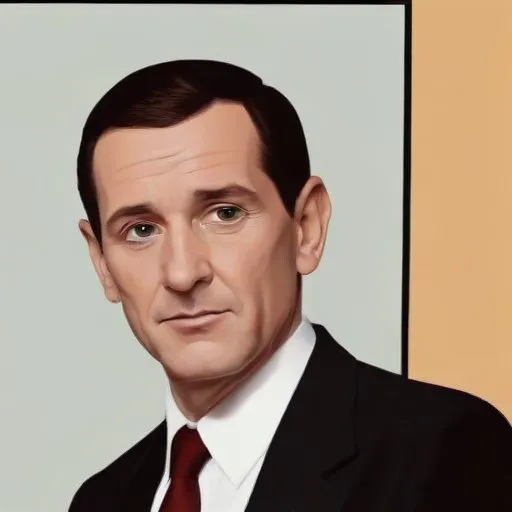
Harvey Quaytman: The Master of Geometric Abstraction
A Painter of Power and Precision
Harvey Quaytman was a renowned American painter, best known for his large-scale, modernist canvases that exploded with powerful monochromatic tones and layered compositions, often featuring hard edges. His work was deeply influenced by the pioneering artists
Kazimir Malevich and
Piet Mondrian, and he went on to carve out his own unique niche in the world of geometric abstraction.
A Life of Art and Turmoil
Born on April 20, 1937, in Far Rockaway, Queens, New York, Quaytman's life was marked by both creativity and tragedy. His father, Marcus Quaytman, a certified public accountant, and his grandfather were killed in a train crash in Queens when Harvey was just three years old. This early loss would later influence his artistic expression, as he sought to convey emotions and ideas through his work.
Education and Early Career
Quaytman attended Syracuse University from 1955 to 1957, before transferring to Tufts University and the School of the Museum of Fine Arts in Boston, MA, where he graduated with a BFA in 1959. It was during this period that he met his first wife, Susan Howe, a fellow painting student who would later become an award-winning American postmodern poet. The couple had a daughter, Rebecca Quaytman, in 1961, who would also go on to become a respected abstract painter.
A Life of Love, Loss, and Artistic Exploration
Quaytman's personal life was marked by multiple marriages and relationships. He divorced Susan Howe in 1965 and later married painter Frances Barth, with whom he remained until their divorce in 1980. In 1989, he married writer Margaret Moorman, and the couple had a daughter, Emma. Throughout his life, Quaytman continued to explore new ideas and techniques, pushing the boundaries of geometric abstraction.
Award-Winning Career
Quaytman's contributions to the art world were recognized with numerous awards and honors. He received two CAPS Grants, in 1972 and 1975, and two Guggenheim Fellowships, in 1979 and 1985. He was awarded an Artists Fellowship from the National Endowment for the Arts in 1983 and became a Member of the National Academy of Design in 1993. In 1994, he won the Elizabeth Foundation Prize for Painting, and in 1997, he received the Academy Award in Art.
A Legacy of Beauty and Emotion
Throughout his career, Quaytman's work was characterized by its powerful simplicity and emotional depth. His canvases seem to vibrate with energy, as if the colors and shapes are alive. Today, his work can be found in the collections of many top public museums, including the Museum of Modern Art, the Whitney Museum of American Art, and the National Gallery of Art.
Remembering Harvey Quaytman
Harvey Quaytman passed away on April 8, 2002, leaving behind a legacy of artistic innovation and expression. His work continues to inspire generations of artists, and his commitment to pushing the boundaries of geometric abstraction remains unparalleled.
Quaytman's Quotes and Wisdom
- "I'm not interested in making paintings that are just decorative. I want to make paintings that are capable of conveying complex emotions."
- "The edge is the most important thing in my paintings. It's the edge that gives the painting its energy."
Personal Milestones and Key Life Events
- 1937: Born in Far Rockaway, Queens, New York
- 1940: Father and grandfather killed in a train crash
- 1955-1957: Attended Syracuse University
- 1959: Graduated with a BFA from Tufts University and the School of the Museum of Fine Arts
- 1961: Daughter Rebecca Quaytman born
- 1963: Moved to Soho, New York City
- 1965: Divorced Susan Howe
- 1972 and 1975: Awarded CAPS Grants
- 1979 and 1985: Awarded Guggenheim Fellowships
- 1980: Divorced Frances Barth
- 1983: Awarded Artists Fellowship from the National Endowment for the Arts
- 1993: Became a Member of the National Academy of Design
- 1994: Won the Elizabeth Foundation Prize for Painting
- 1997: Received the Academy Award in Art
- 2002: Passed away on April 8
Impact on Modern Art
Harvey Quaytman's contributions to geometric abstraction have had a lasting impact on modern art. His work has inspired a new generation of artists to experiment with color, shape, and emotion. Today, his legacy continues to grow, as his paintings remain a testament to the power of art to convey complex emotions and ideas.
FAQ
What style of painting did Harvey Quaytman develop?
Harvey Quaytman was an American painter known for developing a unique style that blended abstraction and representation, characterized by bold colors and geometric shapes.
What was Harvey Quaytmans teaching career like?
Harvey Quaytman had a long and distinguished teaching career, serving as a professor of art at several institutions, including the School of Visual Arts and New York University.
What art movements was Harvey Quaytman associated with?
Harvey Quaytman was associated with the Abstract Expressionist and Lyrical Abstraction movements, and was part of a circle of artists that included notable figures such as Willem de Kooning and Mark Rothko.
What exhibitions has Harvey Quaytmans work been featured in?
Harvey Quaytmans work has been featured in numerous exhibitions, including solo shows at the Museum of Modern Art and the Solomon R. Guggenheim Museum.
What is Harvey Quaytmans legacy in American art?
Harvey Quaytman is remembered as a pioneering figure in American art, known for his innovative style and his contributions to the development of abstraction.