


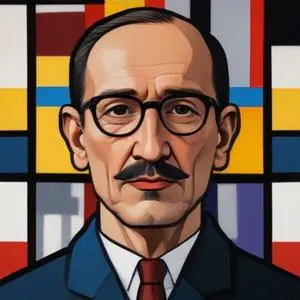
A pioneer of geometric abstraction, creating iconic grid-based paintings that explore harmony and balance. His works have become synonymous with modern art and design.
Piet Mondrian, a Dutch painter and art theoretician, is renowned for being one of the pioneers of 20th-century abstract art. He is celebrated for his radical shift from figurative painting to an increasingly abstract style, ultimately reducing his artistic vocabulary to simple geometric elements.
Born Pieter Cornelis Mondriaan on March 7, 1872, in Amersfoort, Netherlands, Mondrian showed an early interest in art. He studied at the Academy for Fine Art in Amsterdam and later at the Academy for Art and Industry in The Hague.
In the early 1900s, Mondrian's work was influenced by the Impressionist and Fauvist movements. However, as he delved deeper into his artistic identity, he began to reject naturalism, seeking a more universal language in art.
By 1914, Mondrian proclaimed, "Art is higher than reality and has no direct relation to reality. To approach the spiritual in art, one will make as little use as possible of reality, because reality is opposed to the spiritual. We find ourselves in the presence of an abstract art."
In 1917, Mondrian co-founded the De Stijl art movement with Theo van Doesburg, a group dedicated to promoting a new, abstract aesthetic. Mondrian's concept of Neoplasticism, a non-representational form, aimed to create universal beauty through the reduction of art to its essential elements.
He limited his formal vocabulary to:
Mondrian's work had a profound influence on 20th-century art, shaping the course of abstract painting and numerous major styles and art movements, including Color Field painting.
His geometric abstractions have inspired architects, designers, and musicians, transcending the boundaries of visual art.
Some of Mondrian's most notable works include:
Mondrian's innovative approach to art paved the way for generations of artists, earning him a place among the greatest artists of the 20th century.
In 1944, Mondrian passed away in New York City, leaving behind a legacy that continues to inspire and influence artists, designers, and thinkers around the world.
Mondrian's artistic philosophy was deeply rooted in his pursuit of universal values and aesthetics. He believed that art should be above reality, transcending the mundane to achieve a higher spiritual purpose.
As he once said, "The essence of art is the expression of feelings."
Did you know that Mondrian was a talented musician and played the violin in his spare time?
He also had a unique approach to dress, often wearing a three-piece suit with a white shirt and a bow tie, creating a striking visual harmony that mirrored his artistic style.
In conclusion, Piet Mondrian's groundbreaking contributions to abstract art have left an indelible mark on modern society, inspiring artists, designers, and thinkers to strive for universal beauty and spiritual expression.
Born in 1883
A Dutch artist who founded the De Stijl art movement, characterized by geometric shapes and primary colors, and is known for his abstract paintings and architectural designs.
Born in 1882
A pioneer of Cubism, creating fragmented forms and multiple perspectives in art, revolutionizing modern art movements.
Born in 1881
A pioneering artist who transformed modern art with pioneering Cubist works, creating a new visual language that continues to inspire and influence art, design, and culture.
Born in 1869
A pioneering artist who revolutionized modern art with bold, expressive, and colorful works that blurred the lines between painting and sculpture, creating a new language of form and color.
Born in 1878
A Ukrainian painter and theorist who founded the Suprematist movement, creating geometric abstract works that explored the emotional and spiritual properties of color. They're most known for their iconic "Black Square" painting.
Born in 1871
A German-American painter and illustrator who blended cubism and futurism to create vibrant, abstracted cityscapes and seascapes, influencing the development of modern art.
Born in 1885
A pioneer of Orphism, a style of abstract art that emphasizes geometric shapes and vibrant colors, creating dynamic and expressive works that explore the emotional potential of color. 42
Born in 1881
A pioneer of Cubism, this artist's bold, geometric works blended modernity with ancient forms, influencing generations of artists and designers.
