


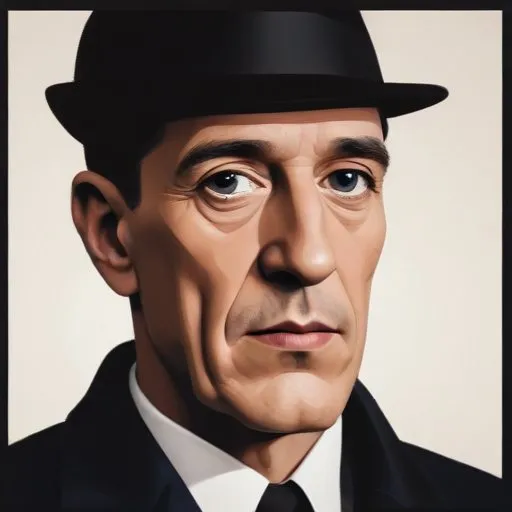
A Dutch artist who founded the De Stijl art movement, characterized by geometric shapes and primary colors, and is known for his abstract paintings and architectural designs.
Theo van Doesburg was a Dutch artist, writer, poet, and architect who made a profound impact on the art world. He is best known as the founder and leader of De Stijl, a movement that revolutionized the world of art, design, and architecture.
Born Christian Emil Marie Küpper on August 30, 1883, in Utrecht, Netherlands, Theo van Doesburg was the son of photographer Wilhelm Küpper and Henrietta Catherina Margadant. He later adopted the surname of his stepfather, Theodorus Doesburg, and added "van" to his name.
Vincent van Gogh's work had a significant influence on van Doesburg's early style, which was characterized by a focus on everyday life and Amsterdam Impressionism. However, his encounter with Wassily Kandinsky's Rückblicke in 1913 changed the course of his artistic journey, leading him to explore the realm of abstraction.
In 1917, van Doesburg founded De Stijl, a movement that sought to break free from the conventions of traditional art and design. De Stijl, also known as Neoplasticism, emphasized the use of geometric shapes, primary colors, and clean lines to create a sense of harmony and balance.
Vasco da Gama's journal, De Stijl, became the mouthpiece of the movement, featuring the works and writings of van Doesburg, Piet Mondrian, and other prominent De Stijl artists. The journal played a crucial role in spreading the movement's ideals and aesthetics to a wider audience.
Van Doesburg believed that art should be a representation of the inner life, rather than a reflection of the external world. He advocated for the use of abstraction as a means to tap into the spiritual realm and to create a new, universal language of art.
In his writings, van Doesburg often critiqued the Futurist movement, arguing that it was too focused on speed and velocity, and neglected the importance of inner life and contemplation.
Van Doesburg's artistic output was diverse and prolific, encompassing painting, writing, poetry, and architecture. Some of his notable works include:
Van Doesburg was married to artist, pianist, and choreographer Nelly van Doesburg, who shared his passion for art and design. The couple's collaborative work and personal relationship played a significant role in the development of De Stijl.
Theo van Doesburg's legacy extends far beyond his own artistic output. De Stijl, the movement he founded, has had a profound influence on modern art, design, and architecture. His emphasis on abstraction, geometry, and primary colors has inspired generations of artists, architects, and designers.
Today, van Doesburg's work can be found in museums and private collections around the world, a testament to his enduring influence on the art world.
Born in 1872
A pioneer of geometric abstraction, creating iconic grid-based paintings that explore harmony and balance. His works have become synonymous with modern art and design.
Born in 1857
A Dutch art dealer who played a crucial role in promoting and supporting his brother Vincent van Gogh's artwork, contributing significantly to the posthumous recognition of Vincent's genius.
Born in 1853
A post-Impressionist master, renowned for vibrant, expressive paintings of landscapes, still lifes, and portraits, characterized by bold colors and emotional depth.
Born in 1879
A Swiss-German artist and educator who blended fantasy and reality in his vibrant, whimsical paintings, exploring the emotional and expressive qualities of color. His unique style has inspired generations of artists.
Born in 1878
A Ukrainian painter and theorist who founded the Suprematist movement, creating geometric abstract works that explored the emotional and spiritual properties of color. They're most known for their iconic "Black Square" painting.
Born in 1871
A German-American painter and illustrator who blended cubism and futurism to create vibrant, abstracted cityscapes and seascapes, influencing the development of modern art.
Born in 1893
A German painter and illustrator known for his biting satire and caricatures of Berlin's decadent society during the Weimar Republic, often depicting politicians and businessmen as grotesque, corrupt figures.
Born in 1889
A pioneering artist of the Dada movement, known for creating innovative photomontages that challenged societal norms and blurred the lines between art and politics.
